States with the most auto repair shops per capita
Which US state has the most auto repair shops per capita? See where your state stands as we rank all 50 U.S. states.
August 6, 2026 · Arnold GoldLinkedIn profile of Arnold Gold · 4 minutes read

Take a wild guess at the state with the most auto repair shops. If you said California, you’d be wrong.
Here’s what the data shows.
- California has the highest number of repair shops, at 20,998, but compared with its population of 39,355,309, the state ranks #24.
- Wyoming has 494 establishments, but with the population count of 588,753, it’s all the way at the #1 position.
- Texas has the second-highest number of auto repair shops, 14,614, but ranks #42 due to its population of 31,709,821.
- Mississippi lands close to the middle with a population of 2,954,160 and 1,573 repair shops.
- Arizona sits at the other end. Its population of 7,623,818 is more than 12 times Wyoming’s, but with only 3,230 shops, it lands at #50, the lowest-ranked state.
According to the U.S. Bureau of Labor Statistics, 176,403 automotive repair and maintenance establishments were operating in the U.S. as of the fourth quarter of 2025.
To see where those 176,000-plus shops actually are and where they’re scarce, Way pulled state-level data from BLS’s Quarterly Census of Employment and Wages (QCEW) for NAICS 8111, Automotive Repair and Maintenance, and measured the shop density relative to each state’s population.
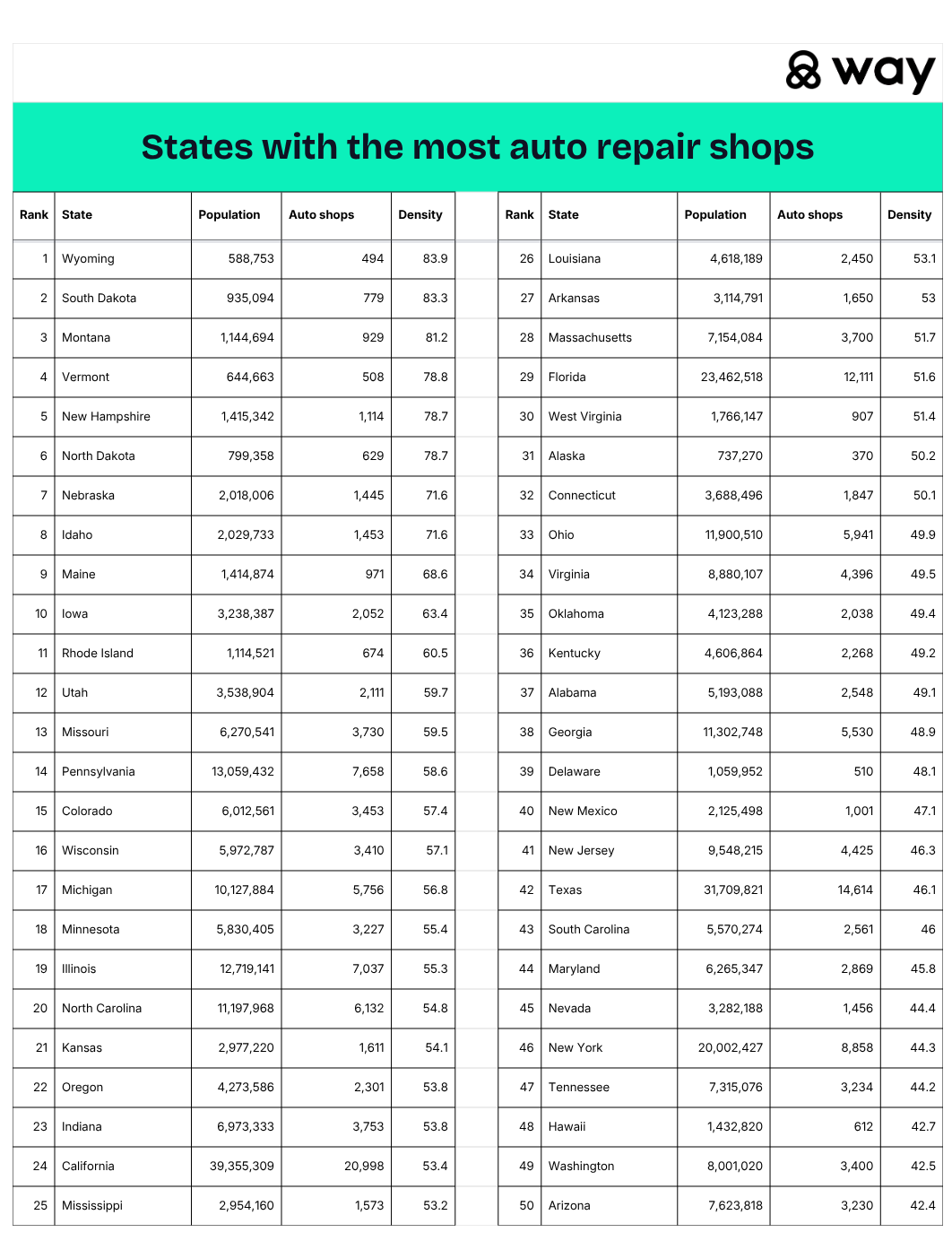
National average: establishments/population x 100,000 = 51.6 per 100,000.
District of Columbia is included in the table above for reference but is not a state. Puerto Rico (853 establishments) and the U.S. Virgin Islands (16 establishments) are not included.
What the table shows
Wyoming, South Dakota, Montana, Vermont, New Hampshire, and North Dakota have two things in common: they are all large in land area and sparsely populated. In places like these, you need a car to get by and a shop nearby for repairs. These are also states where residents log some of the highest vehicle miles, suggesting that the density can reflect how dependent they are on cars in their daily life. For instance, the FHWA’s Traffic Volume Trends 2025 report shows that Wyoming logged 742 million vehicle miles traveled (VMT) in November alone. That is a high traffic volume for a state of under 600,000 people.
There’s also a larger reason why the number of auto repair shops matters, wherever you live in the U.S. According to the Federal Highway Administration, the total number of registered motor vehicles in the U.S. in 2024 was 297,525,836. Vehicles are also getting older, with the average age being 12.8 years, and the price of buying a new car has gone up too. Kelley Blue Book reports that the average price paid by a driver was $49,814 in November 2025, which is 1.3% more than a year earlier. At the same time, repairs cost more than they used to. As per the Bureau of Transportation Statistics’ CPI tracking, vehicle maintenance and repair prices were up 5.4% year-over-year as of December 2025, and roughly 51% higher than they were in January 2019.
From this, we can assume that Americans are clearly holding on to their cars longer, and when something goes wrong, most drivers aren’t trying to fix it themselves. Instead, they’re calling a mechanic, but where you live decides how many options you have when it’s finally time to book an appointment.
What does this mean for you?
Shop owner
Hiring will be the biggest challenge you’ll face, as more than 800,000 technician job openings are expected across the states every year until 2034. The number of shops per 100,000 people alone won’t tell you whether a market is worth doing business in, but it’s a good place to start. Just make sure to consider the local labor rates and shop rent prices as well.
Driver
The shop density will affect your choices and prices. A state with a low shop density means you’ll have fewer choices nearby, and the wait times will be longer during high-demand seasons. On the other hand, if you live in a high-density state, you’re likely to have more options with more affordable pricing. It’s important to keep in mind that not every shop is equal. It’s worth checking the reviews and asking around before you decide to book.
Sources
Quarterly Census of Employment and Wages (Q4, 2025)
Traffic Volume Trends (December 2025)
Transportation Economic Trends