How to start your own repair shop (A 7-step guide)
Have no idea how to start an auto repair shop? This 7-step guide walks you through everything from writing your business plan to getting customers through the door.

When the economy is tight, as it is now, people aren’t thinking of replacing their beat-up cars with shinier, newer ones. They’re going to keep the old one running as long as they can. With cars becoming more complex, fewer people trust themselves to fix their cars on their own, which is great business for you!
Of course, building a business from scratch isn’t a walk in the park. So, here’s a quick guide that’ll take you through the steps of opening your very first auto repair shop.
Step 1: Have a plan
Seems obvious, but it’s the only place to start. You probably already have an idea of what you want to do; that becomes your niche. Are you going to go for general repairs, specialize in one thing, or are quick services more of your forte?
Once you decide your area of expertise, scope out the competition around your neighborhood. Figuring out how many shops already exist, the services they provide, the prices they charge, and the perks they offer is a good way to see how you can stand out.
After that, you need to write it all down. This is where you need to get into the specifics, from the company description and management to the financial plan and marketing strategy. A formal document with all the details isn’t just for your own clarity; it will also help you when you’re pitching your shop to a lender, an investor, a landlord, or even a future business partner.
When you browse sites like LoopNet for properties and Mechanic Super Store for equipment, you’ll be able to get a ballpark estimate of the budget you need. Don’t forget to add the costs of licenses, insurance, inventory, capital, hiring, marketing, and other miscellaneous expenses. As a rough guide, a modest 2 to 4 bay independent shop may land between $75,000 and $200,000. The prices can differ if you’re leasing a space and buying used equipment. You should treat any figure, including the one we mentioned, as a starting point and only finalize a budget after you get real quotes in person.
In terms of funding your shop, the most common option is going with Small Business Administration (SBA) loans. These are particularly for small businesses and are partially backed and guaranteed by the U.S. Small Business Administration. There are also other financing options like equipment financing, where the equipment itself is collateral, a business line of credit that lets you borrow money as you need it, personal savings, or investment from partners. Each one does come with its own requirements and trade-offs, so make sure you’re thinking it through.
Step 2: Set up your legal and financial essentials
Think about how you want to set up your shop legally because it affects your taxes and personal liability.
For many small repair shops, a limited liability company (LLC) is the go-to because it separates your personal assets from your business, giving you more protection. A sole proprietorship is where you and your shop are essentially the same entity, so if any problems happen to your business, you’ll face the personal consequences too. If you’re opening the shop with someone else, a partnership makes the most sense. You’ll be sharing all the responsibilities, including the profits and losses. Then there are corporations, which come with their own tax rules.
Once you’ve decided how you’re setting up the business, pick out a name for your shop, register your business, and get an Employer Identification Number (EIN). This is a free number you get from the IRS to file taxes, open a business account, or hire employees.
License and permit requirements are not the same everywhere, so make sure to check for state-specific requirements before you buy equipment or rent a property to start your repair shop. Another thing to keep in mind is that your city and your state might have separate rules for taxes and environmental compliance. Online information about these may not always be accurate. You should, therefore, check with your nearest DMV or state licensing board and get the latest list from them.
Your new auto repair shop will also need insurance. General liability and garagekeepers coverage are the most important among them. The first protects you should a third party make a claim against your business, while the other covers the vehicles that are in your shop. We recommend you also take out property insurance (for your building and equipment) and workers’ compensation once you start hiring. If you plan on offering towing services, include commercial auto coverage for your tow trucks.
Step 3: Find a suitable location and space
Ideally, your repair shop should be a place that people can easily see as they drive past, and it should also be easy to get to. The last thing someone with a broken-down car wants to deal with is getting to a hard-to-access repair shop! Also, check zoning and other local laws. There might be city/location-specific requirements for lifts, floor drainage, wiring, and ventilation.
You should also consider having a waiting area, an office, parts storage, etc. It would be a good idea to have a checklist when you visit properties. We’d even go so far as to say keep it old-fashioned with a printed checklist (where you can scribble notes) because your phone or tablet might run out of charge.
Depending on how much money you are investing, you can either lease or buy the property for your auto shop. Most first-timers go in for a lease because it’s cheaper. However, if you have enough funds and you think buying would be the better choice, go ahead. You’ll build equity and have full control over renovations.
Step 4: Choose your parts suppliers
A mistake a lot of shop owners make when picking a parts supplier is choosing just one. When it comes to suppliers, you should work with both local and national distributors. Waiting on a delivery is time spent sitting idle, and when you can’t deliver the car at the promised time, your customers will never think about coming back. Building relationships with a few reliable parts suppliers will come in handy when you need parts ASAP for an emergency repair. It will also be helpful when one of them doesn’t have the part you want.
Step 5: Invest in good shop management software
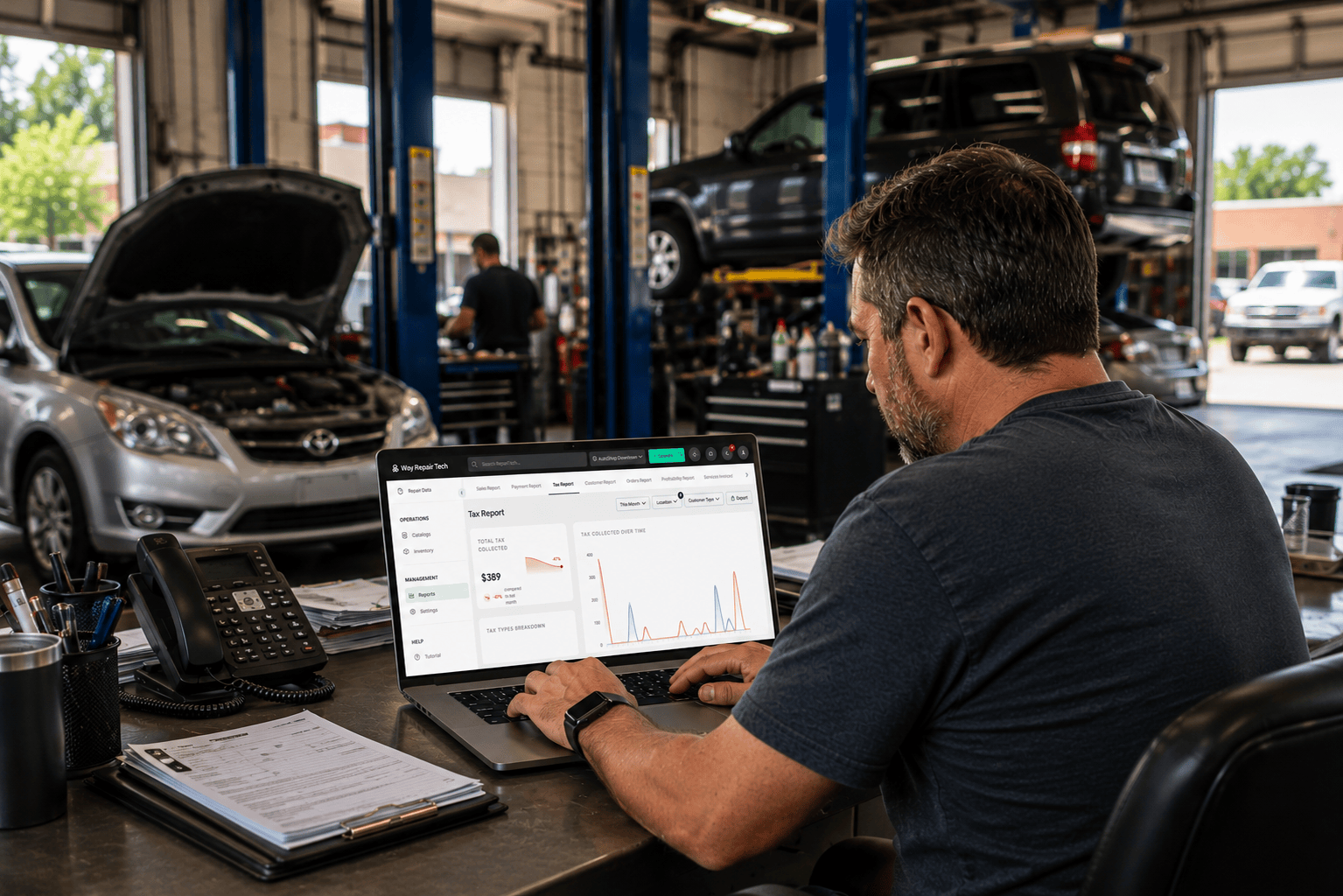
You may think you can manage your shop with a spreadsheet and sticky notes, but implementing software from the start will save you a lot of time and stress later. When you search for shop management software, you’ll come across many that have the same basic features: scheduling, inventory, invoicing, and reporting, to name a few. These are non-negotiable, but there are other features you need to keep an eye out for, like digital vehicle inspections, customer relationship management, appointment booking, and integrations.
Step 6: Hire good techs and service advisors
Doing everything on your own works out fine when you only have a handful of customers to handle. As your bays get filled with more cars, it will get tougher to be in two places at the same time. You can either talk to the customers or get on with the repairs.
Your first hire doesn’t necessarily need to be a whole team of technicians. One experienced tech who can handle advanced jobs is the perfect starting point. This way, you can leave the repairs to the tech, and you can manage the customers.
A service advisor becomes necessary once you get too busy, and someone needs to be there to explain things to your customers and become the sounding board for your techs. If you’ve worked as a mechanic before, you understand how important proper training and good work culture are. So, whatever you do, never compromise on those!
Step 7: Market your shop well
Once you’ve opened your shop, you need to focus your energy on marketing. Word-of-mouth works until it doesn’t.
You can start by updating your Google Business Profile by listing your working hours, photos, services, and contact information, and always keeping it current.
There is a plethora of free templates out there. Choose the simplest one and create a website. This is where your customers should go to look up prices and book appointments instead of blowing up your phone.
Everyone depends on reviews these days, even for a small thing like a potato masher, so make sure you’re asking for them. Keep your tone polite, and if they refuse, don’t pressure them. The best time to request a review is a day after the repair. You’ll also get negative reviews here and there, which you need to address professionally.
Word-of-mouth still works, so try to build good relationships with your neighborhood and local businesses. A few ideas you can try are sponsoring a local sports team, partnering with a car wash, hosting a car workshop, or setting up discounts for fleets.
Conclusion
The first few months will definitely be difficult. You’ll be running around a lot, your only customers might be your family and friends, the expenses will start to pile up, and you might even regret opening the shop in the first place. Some techs might be no-shows some days, and you might have more slow Tuesdays than you can count. But once you build trust through fair prices, great service, and shop management software that keeps track of everything, you’ll eventually see more customers coming through the doors.
Running an auto repair shop is definitely easier with the right tools. Schedule a demo to see how Way Repair Tech can help you.