“Service tire monitor system” warning: What every tech should know
A customer came into your shop with a “service tire monitor system” warning. Here’s how techs can diagnose the fault, run the right relearn, and avoid comebacks.
October 27, 2026 · Arnold GoldLinkedIn profile of Arnold Gold · 7 minutes read

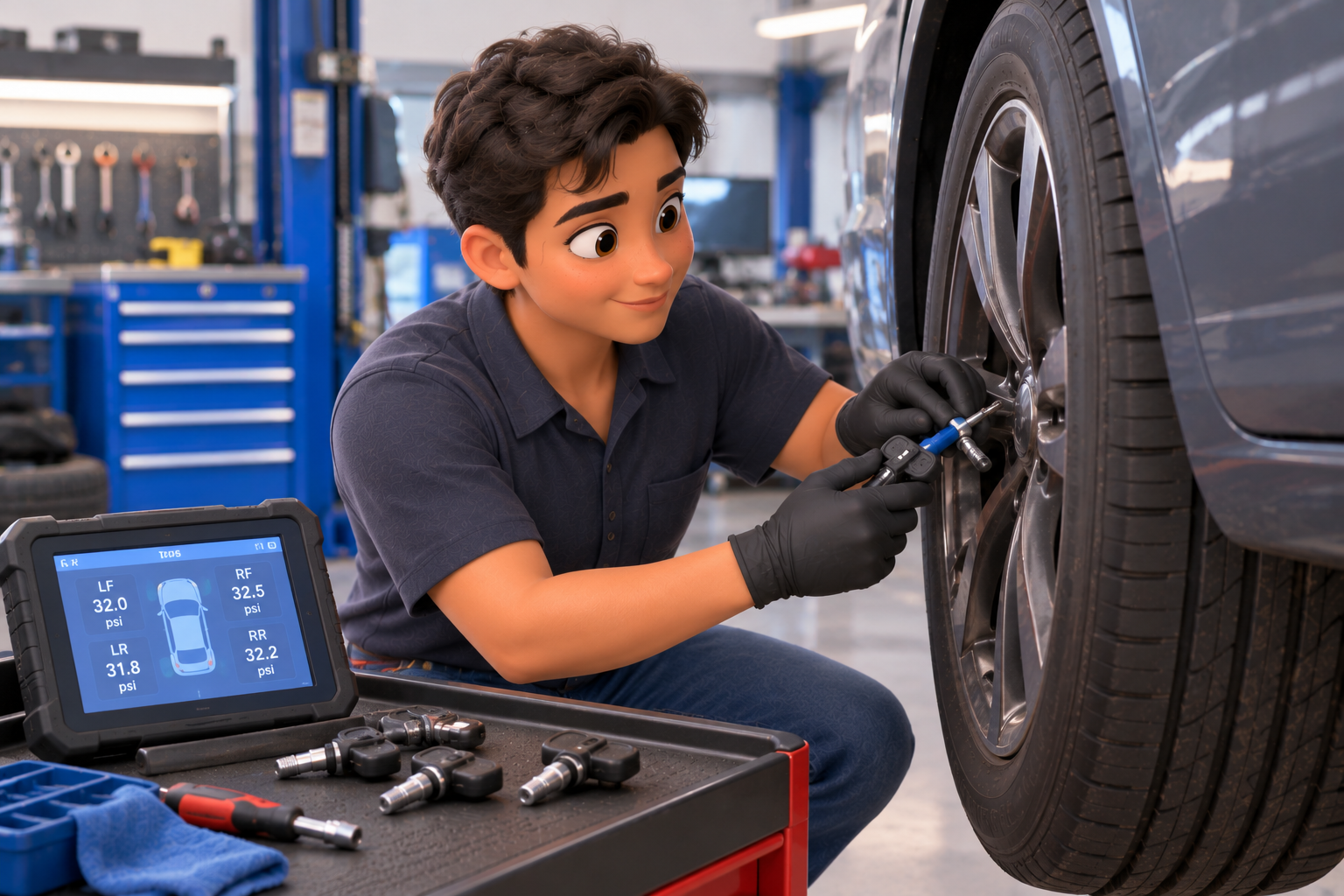
Under the TREAD Act and Federal Motor Vehicle Safety Standard (FMVSS No. 138), all new passenger cars and light trucks (10,000 lb GVWR or less) manufactured for sale in the U.S. on or after September 1, 2007, must have a tire pressure monitoring system (TPMS). So, if you work in a tire shop or even a general repair shop, you’ll come across this warning sooner or later. With TPMS coming in direct and indirect types, you should be able to be certain that the procedures you’re following are down to a T. Any missed step can mean a comeback.
What does “service tire monitor system” mean?
If a customer says the service tire monitor system message is on, either the tire pressure is typically 25% below the recommended pressure or the TPMS itself has a fault. There are two types of TPMS: direct and indirect. It’s important that you know the difference, so you don’t waste time on an unnecessary sensor replacement.
Direct TPMS uses battery-powered sensors inside each wheel to measure actual pressure and temperature, and the sensors transmit wirelessly to the vehicle’s receiver.
Indirect TPMS has no sensors in the wheels. It uses the anti-lock braking system (ABS) wheel-speed sensors to spot a low tire, because an under-inflated tire spins at a different rate.
What causes a “service tire monitor system” warning?
Dead or failing sensor batteries are one of the most common causes. The batteries are found inside the sensors, so a dead battery means the sensor needs replacement. The batteries usually last five to ten years, and when one of them fails, the rest will follow closely behind. That’s why it’s recommended to replace all of them at the same time.
Sometimes the sensors themselves are damaged or broken. In such cases, look for corrosion on the valve stem or a cracked sensor. A customer may have used sealant on a puncture, which can clog the sensor.
After rotating or swapping a sensor, improper calibration or relearning can trigger the warning. This means that the sensors work, but the vehicle doesn’t know where those sensors are.
Some vehicles also monitor the spare tire. If its sensor is dead, or a spare without a matching sensor is swapped in after a flat, the light can come on even when every road tire is fine.
If there’s an extreme pressure drop, the sensor will be out of range or go offline. Reinflate to the placard pressure and check whether the sensor comes back. If it doesn’t, the cause is something else.
After a flat tire is inflated to a new pressure or replaced, an indirect system needs a reset to learn a new baseline. Without it, the system works from old data and can trigger a warning.
There are times when the tires are mismatched or uneven, which can cause the warning. On an indirect system, this can change the rolling diameter, which can confuse the system.
Scan for stored codes if every sensor reads fine and the light stays on, since a wiring fault or a failing TPMS or body control module can keep the light on.
How do you diagnose a service tire monitor system?
Figure out whether the vehicle uses a direct or indirect TPMS. The two systems work differently, so knowing which one you’re dealing with will help you narrow down the possible causes.
Check the tire pressures and set them to the recommended levels on the door jamb placard. Don’t forget the spare if it has a TPMS sensor. If a tire’s pressure is right at the sensor’s wake-up threshold, the sensor might not send a signal during testing.
Before attempting a relearn, use a TPMS tool to check each sensor’s ID, pressure, temperature, battery status, and signal strength. If a sensor doesn’t respond, roll the vehicle forward a few feet and try again. The brake rotor can sometimes block the signal. If the sensor still won’t respond, it may have a dead battery or be operating on the wrong frequency.
A standard scan tool can reveal module faults and communication errors that a relearn procedure won’t fix, saving you time chasing the wrong problem.
Find out whether the vehicle recently had a tire rotation or sensor replacement. Also, inspect the valve stems and sensor bodies for corrosion, damage, or sealant buildup.
What are some relearn procedures by manufacturer?
The procedures below are summarized from ASE Study Hub’s TPMS relearn guide. Always confirm the exact steps in OEM service information for the vehicle in front of you.
General Motors
GM vehicles often use a stationary relearn procedure. On newer models, you can enter learn mode through the Driver Information Center. Starting at the left front, work clockwise around the vehicle and trigger each sensor with a 125 kHz TPMS tool. The horn should chirp to confirm each sensor has been learned. If you don’t get a chirp within a minute or two, the system may time out, and you’ll need to start again.
Ford
For Ford, there’s a specific ignition and brake pedal sequence that goes left front, right front, right rear, then left rear. If you have a scan tool that can activate learn mode through the on-board diagnostics (OBD) port, use it to make the process easier and avoid timing issues. Before ordering replacement sensors, you need to check the frequency. A 315 MHz sensor and a 433 MHz sensor may look identical, but they’re not interchangeable.
Toyota and Honda
Manufacturers like Toyota often require an OBD-II relearn. You’ll need to read each sensor’s ID with a TPMS tool, then register those IDs with the vehicle through the diagnostic port. The “Set” button that’s often hidden under the glovebox or dashboard doesn’t register a new sensor. The button will only activate the system after adjusting the pressure.
Honda can be a little different. Many newer models use indirect TPMS. That means there’s no individual wheel sensor to relearn. For such models, all you have to do is set the tire pressures to the recommended levels, start the calibration through the dashboard or infotainment system, and drive at a steady speed for around 20 minutes, following the vehicle’s specific instructions.
European makes
BMW and some other European vehicles use an automatic relearn process. Enter the correct tire size and load settings in the iDrive menu, select the reset option, and take the vehicle for a drive. Depending on the model, you may need to drive above roughly 20–25 mph for 15–20 minutes while the system identifies the sensors and their positions.
Similar to Honda, many Volkswagen and Audi models use indirect TPMS, so start by setting all tires to the exact pressures listed on the door placard, as well as making sure they are of the same brand and have the same tread depth.
Confirm the relearn is complete
Once the relearn is finished, check that the warning light has gone out and that every sensor is reporting correctly. Record the sensor IDs and document the completed procedure on the repair order. Keeping a record of the work helps show that the system was functioning correctly when the vehicle left your shop.
What to quote
The pricing actually depends on the model of the vehicle and your local labor rates. If you’re using the original equipment sensors, it will cost more than the aftermarket options. Many shops quote roughly $50 to $250 or more per sensor installed.
Bottom line
By following the procedures specified by the OEM for different vehicles, using the right tools for the job, and relying on your diagnostic data, you will be able to reduce the risk of comebacks.