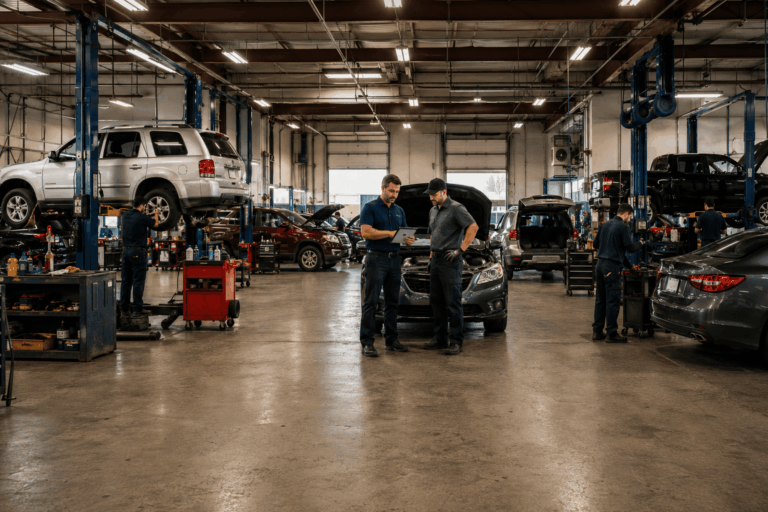

Your shop floor is where the actual work takes place. So, when your shop floor does not have smooth operations, you are not just losing valuable time and resources. You are compromising customer service quality, bay usage, and your employees’ productivity. When this happens, your shop will turn haywire, and you will start losing business. How do you overcome this? You start by implementing shop floor management.
Shop floor management is when you use strategies and tools to make daily operations on the floor consistent by keeping the teams coordinated with one another. This means you are not relying on gut feeling. Rather, you are monitoring and continuously improving your shop floor, covering areas like how bays are assigned, how jobs are tracked, how technicians are deployed, how parts get where they need to be, and how customers are handled. When you shift your focus to the correct approach, your floor will go from chaotic to structured.
Why does shop floor management matter for R&M shops?
Too many cars, not enough bays
You run a busy shop, and it works well until it doesn’t. Without a proper system in place, especially for bay allocation, your floor becomes similar to a parking lot. Bay management assigns work to the right space as cars arrive. So instead of guessing where the cars go, you are taking measures before it becomes a problem.
Technicians waiting or blocked
Nothing kills productivity faster than a technician having jobs pile up or worse: sitting idle. Good shop floor management keeps every technician moving at the right speed at the right time.
Jobs getting delayed
Sometimes, delays happen because of simple things like a wrong bay, a missing tool, a part not ordered, or no one noticing the car was done. If you have a shop floor management system, everyone is on the same page because they are viewing real-time data. This means efficiency takes the wheel, not incompetence.
Poor visibility
Maybe a customer is calling for updates, or parts are being delivered, but you don’t know what’s going on. If you or the team leaders have to understand what is happening by physically going to the floor, then it’s a waste of time. With shop floor management, this problem is solved because you are viewing everything on the system.
How should shop floor management in auto repair be?
Unfortunately, there is no universal approach to floor management, which is why planning matters as much as execution. Successful floor management depends on what works for your business at the moment, as well as when it eventually expands. This means your plan must include removing unnecessary items, organizing your workflows and area, cleaning and inspecting your shop, creating regular processes, and maintaining these through training and inspections. Here’s how to achieve this:
Flow-first shop layout
Your shop should have prioritized zones, such as car intake, inspection, repair, quality control, and delivery. This way, cars follow a specific flow and aren’t moved around unnecessarily, causing confusion and delays. Map out the current flow and then start designating the locations to make sure cars don’t enter the next section before the previous one is completed.
Bay management system
Like how not all jobs are the same, not all bays are the same. A quick oil change shouldn’t be in the same bay as heavy restructuring. Allocate bays depending on the duration, type, and requirements. Also, make sure each bay is equipped with the necessary tools so your technicians aren’t fussing over them being missing or misplaced. Marking the bays with a name or number is also highly recommended.
Visual shop floor control
Never let your technicians rely on their memory to update the status of their work. Help them track their progress with clear markings and color codes on a digital tool. This is also practical for a new technician to see where the last one left off so they can continue. With proper visuals, you can also ensure no bay is left empty, the progress is recorded, and the job is finished on time.
Parts and tool organization
A messy shop floor isn’t benefiting anyone. A technician hunting for their tools for 10 minutes over three times a day is a huge problem. Besides, it is a disaster waiting to happen. So, sort tools and equipment into fixed locations and arrange the fast-moving parts near the bays. Only slow-moving parts need to be stored in a common space.
Standard operating procedures
Consistency is at the core of effective shop floor management. There are universal guides on standardization. You can either stick to it or create a new one that fits your business.
Your customers matter the most. If you start missing their calls, putting them on hold, or transferring them to different teams, you’re not providing the best service. Once your customers realize they aren’t offered a quality experience, they start looking for other options. Creating standard procedures is, therefore, vital.
Guide your technicians and operators to follow it thoroughly and improve over time. Otherwise, it’s all for naught.
How to employ shop floor management (3-phase rollout)
Implementation practically starts with creating a shop floor design, which means you are ready to move on to the next step. Your employees are familiar with the current workflow, and a sudden change can cause confusion. A phased plan will ease you and your employees into the new framework.
Phase 1: Pilot
Usually, TV shows have a pilot episode to test the idea before fully committing to it. This is similar. Conduct a trial run to understand what works and what doesn’t to plan for alternatives. 2-4 weeks is a good timeline for a mini version before a full-scale rollout.
Phase 2: Controlled expansion
Once you understand the results, you can initiate the plan for the other teams. We suggest skipping the busiest team in this phase so that the customer flow isn’t disrupted. You should conduct daily huddles for each team to brief them on why this is important, so no step is ignored or missed. This phase takes place from week 5 to 10. However, remember that the process requires more time because multiple teams are working together in parallel.
Phase 3: Full rollout
The last phase is the shop-wide scaling. This is meant to train every technician based on their team and role. Be careful not to over-complicate your workflows, as this will result in the failure of the approach. Your employees might find it difficult to follow the new operations, so give them time to adapt to the changes.
How do digital tools improve shop floor management?
Using pen and paper or even whiteboards may work well for a while, but as your business grows, these traditional methods will not be scalable. This is where digital tools become essential. They will bring transparency and flexibility to your shop. Some features to look out for:
Real-time tracking
With real-time tracking, there is no need to walk the floor or call multiple people to understand your shop’s progress. This means you know the current and upcoming tasks of your employees. Also, when a customer calls for a service or an update, the call isn’t ignored or redirected. Instead, the information is given promptly.
Bay visibility
See which bay is occupied, which is vacant, and which will free up soon to reassign bays as priorities change.
Technician allocation
Log the hours your technicians work automatically so you can assign tasks as they finish without them writing a report.
Parts readiness
You cannot pick up the phone at the last minute to order parts. With the parts ordering integration, employees can see its availability and order in advance.
While you can utilize multiple digital tools for each of these features, it’s way better to have a solution designed for auto repair shops that includes everything you need. This is where Way RepairTech comes in clutch.
Main takeaway
Goals like faster turnaround time, better bay usage, and improved customer experience become attainable with a shop floor management system. It is a tried and proven blueprint, so the question is: when are you going to practice it for your shop?
Frequently asked questions
What is shop floor management in auto repair?
Shop floor management in auto repair means you create clear processes to oversee your shop’s day-to-day operations, coordinate between technicians, manage bay usage, efficiently use resources, and give customers better service quality.
How do you improve workflow in an auto repair shop?
You start by standardizing your operations, then use a digital system to keep track of everything and continuously monitor the performance to see if it’s working and adjust accordingly.
What is a bay management system?
A bay management system is a tool for allocating bays according to specific jobs so that there is a smooth flow, and no bay is left crowded or unattended.
What are the benefits of shop floor management?
Shop floor management increases productivity and reduces downtime. The result is an exceptional customer experience, upgraded operations, and more revenue.
Let us show how Way RepairTech can elevate your shop. Request a demo today.