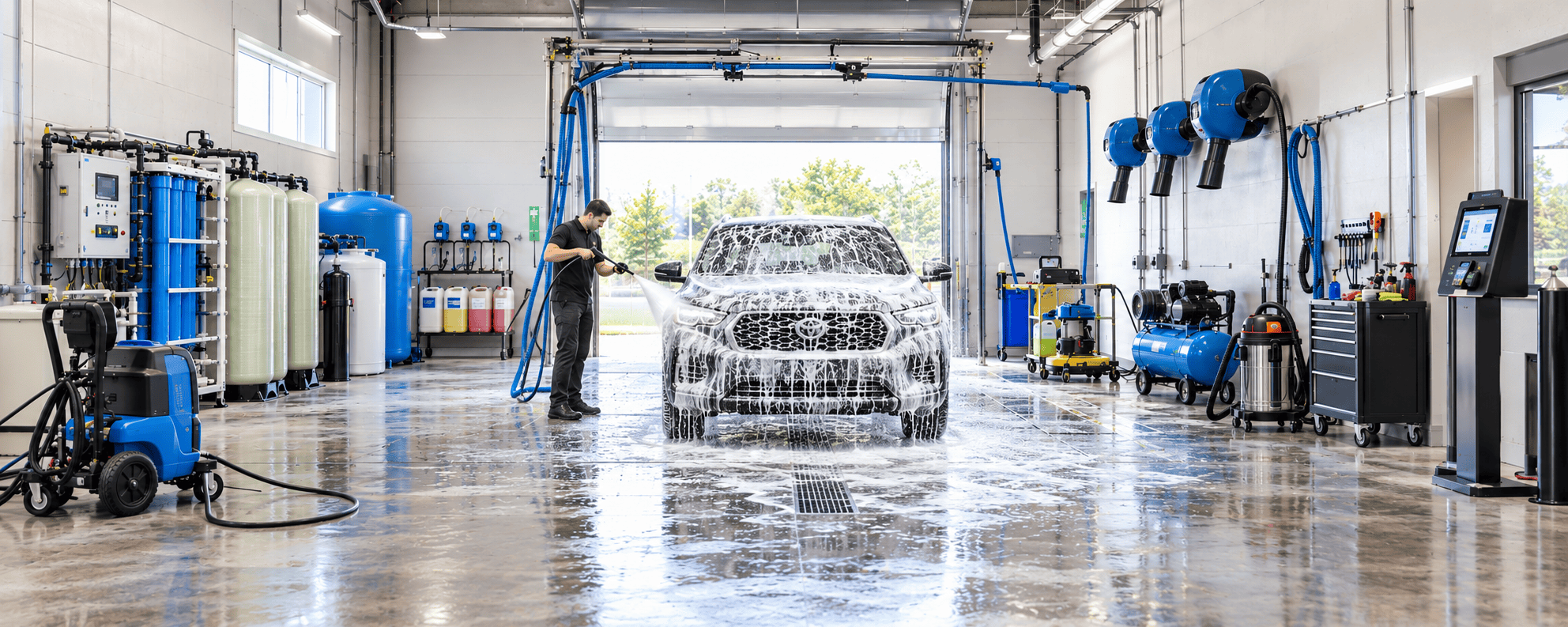
What are the professional car wash equipment options for a new business?
One of the toughest purchase decisions to make when you’re starting a car wash business is figuring out which kinds of professional car wash equipment you need. There are a handful of equipment items you can’t compromise on and others that can wait until later.
The quick answer
The type of car wash you’re planning to run determines the equipment you should prioritize, so decide that first. However, there are several items that are must-haves for every kind of car wash. These typically include a high-pressure wash system, water treatment, chemicals, drying equipment, maintenance gear, and a payment system.
High-pressure wash system
For mobile and handwash setups, a pressure washer with roughly 1,500 to 2,200 PSI (pounds per square inch) and 2.0 to 2.3 GPM (gallons per minute) can provide a good balance of cleaning power and water flow.
Don’t run your pressure washer at maximum pressure, since excessive pressure can damage parts of the vehicle, such as the clear coat. Self-serve, in-bay, and tunnel systems come with pump packages sized by the manufacturer, so ask for the specs on your system.
Water treatment system
Hard water contains high levels of minerals that leave spots behind when the water dries, which is the last thing a customer wants to see after paying for a professional wash. A reverse osmosis (RO) system can give you a cleaner, spot-free final rinse.
Water reclamation system
Water reclamation systems capture and filter wastewater instead of sending it all straight down the drain. Once the water is filtered, it can be reused for presoaks and initial rinsing, which significantly reduces the use of fresh water. In some areas, like California, in-bay and conveyor washes permitted and built after January 1, 2014, must either recycle at least 60% of their wash and rinse water or use recycled water from a water supplier for at least 60% of it. Make sure to check your state and local rules before you buy.
Chemicals
Alkaline high-pH and acidic low-pH presoaks, detergents, wheel cleaners, and drying agents all affect the final result. Touchless systems rely on these because the chemicals have to do more of the work that brushes would normally handle.
Drying equipment
A wash can look great when the car leaves the bay and still end up covered in spots a few minutes later if the water isn’t removed properly. Handheld blowers and towels work well for a smaller car wash. More advanced drying options include high-velocity air dryers and blowers, high-speed absorbent cloth wheels, and spin-dry equipment like chamois buffing wheel.
Maintenance gear
Your car wash facility should also be kept clean and well maintained. Air compressors, grease guns, floor scrubbers, pressure washers, and basic hand tools can make routine cleaning and maintenance much easier.
Payment system
A good point-of-sale (POS) system does more than take payments. It can help you track sales, memberships, customer activity, and day-to-day performance.
Core equipment by car wash type
Mobile or handwash
If you want to start small, this is usually the simplest way to get into the business. A portable pressure washer, water tank, vacuum, and a vehicle or trailer to carry everything are the core items for a low-risk start, along with the chemicals, drying supplies, and payment system covered above.
Self-serve bays
With a self-serve wash, customers do most of the work, so your equipment needs to be durable, easy to maintain, and easy to operate. A typical setup includes pump stands, wash wands, foam brushes, overhead booms, chemical metering systems, and payment equipment.
In-bay automatic
With an in-bay automatic wash, the customer pulls into the bay, parks, and lets the machine handle the wash. Depending on the system, you’ll need a gantry, high-pressure and chemical application equipment, brushes or touchless jets, and dryers.
Tunnel
Tunnel washes are built around one thing: moving a lot of cars through the site. A conveyor carries vehicles through a series of stages, which may include presoak arches, high-pressure washers, brushes, wheel cleaners, rinse arches, wax applicators, and dryers.
Supporting professional car wash supplies
Your equipment will handle most of the cleaning, but you’ll still need certain supplies for touch-ups and interior cleaning. A basic list includes:
- High-quality soap
- Microfiber mitts, towels, and sponges
- Soft-bristle brushes
- Wheel and tire cleaner
- Glass cleaner
- Upholstery and carpet cleaner
- All-purpose cleaner
- Polish and wax
What can wait until after opening
You don’t have to buy every possible piece of professional car wash equipment before opening day. In many cases, it’s smarter to start with the equipment you need to run the business reliably and add extras once you have steady revenue.
For any wash
- Premium add-ons like ceramic coating or dedicated detailing bays
For self-serve and in-bay
- Central vacuum systems
For in-bay and tunnel
- Automated triple-foam and specialty wax arches
A few questions to ask equipment suppliers
- Who services the equipment near your location, and how fast do they respond?
- What happens when equipment breaks down, and how long do repairs usually take?
- How much time does it take from order to installation?
Check your site
Even the highest-quality equipment won’t help you if your site can’t support it. Before placing an order for the equipment, you need to think about water supply, including available pressure and flow, as well as electrical capacity, drainage, sewer connections, zoning, and permits. You need enough room for customers to enter, queue, wash, and exit without backing up traffic into the street.
FAQs
It depends on the type of car wash. A mobile setup can start at a few thousand dollars, whereas a tunnel wash requires a much larger investment when equipment, land, construction, utilities, and other site costs are included.
It can be, particularly for mechanical equipment that has been properly inspected and maintained. However, be more careful with payment systems, electronics, and equipment for which replacement parts or service are difficult to find.
Water quality is one of the most overlooked areas, and it’s easy to underestimate. If your water leaves mineral spots on vehicles, even an otherwise excellent wash can leave customers disappointed. Test your water and choose your treatment system based on the actual conditions at your site rather than assuming you need the most expensive setup.

