
What advantages does embedded roadside assistance provide to auto insurance carriers?
When your customer’s car breaks down in the middle of the road, and they’re completely overwhelmed, their first and only thought is: Who can I ask for help right now?
A dead battery, a lockout, a flat tire, or an unexpected tow are moments when your customers experience the true value of their coverage every day, without ever having to file an accident claim; without impacting their claims history.
Instead of leaving your customers to search online for a tow truck number when they’re stressed, you can redirect them to your portal because roadside assistance is already part of their insurance. It’s available when your customers need it, through the same digital platform they’re familiar with, only a click or phone call away.
“Improve customer satisfaction and reduce churn.” These are the benefits that have been talked about repeatedly. They’re true, but let’s look at those benefits most people aren’t talking about.
Create worthwhile interactions before a claim ever happens
How many times do you interact with your customers in a year? Probably only a handful of times.
This is one of the challenges many insurance carriers face: a lack of interactions. You’re asking your customers to stay loyal to a carrier they almost never hear from.
Wouldn’t it be great if you were always at the top of their mind? A flat tire or dead battery might be small, but being there when it happens is what makes your customers think of you first when it matters the most.
Your response to these minor incidents shows your customers that they can trust you to help them when they desperately need it, not only when something expensive happens.
Show your customers they can rely on you
Most customers don’t really appreciate insurance until something goes wrong.
Roadside assistance changes that. You’re showing your customers that you’re reliable in urgent, everyday situations, and not just when there’s an extreme emergency.
A customer may not remember their coverage limit. But they’ll definitely remember the quick help they received during bad weather or when their car wouldn’t start in a grocery store parking lot.
Customers who experience a reassuring roadside interaction are also more likely to renew their coverage, not because they compared prices, but because they remember how you made them feel when it counted the most.
Get visibility into vehicle issues before they become claims
An advantage of embedded roadside assistance that’s usually missed by insurance carriers is the data it provides.
Repeated battery failures. Multiple tows within a short period. Regular breakdowns. Frequent tire issues. Individually, they just mean it’s time for your customers to get their cars repaired. But together, they can be used to get additional context on customer behavior and vehicle usage that you don’t get from standard policy data.
You can also ask better operational questions such as:
- Where are response times consistently slow?
- Are certain regions underserved?
- How often do roadside events lead to claims or other service needs?
Keep your insurance at the center
Customers associate the good experience they received with whoever dispatched the help. If that’s a third-party business, they get the credit. If it’s your platform, you do.
Turn this into a branding strategy. When in need of assistance, make sure your customers aren’t calling a random number they found on Google but are using your app or website instead. This keeps you in the center of your customer’s experience and not on the sidelines.
By connecting every interaction back to your insurance portal, you’re reinforcing the value you give customers, not someone else.
Reduce customer effort, and not just the response time
What takes place when your customer’s car suddenly stops working?

Too many steps mean too much effort on the part of the customer. This breaks the customer experience, especially when they’re already anxious.
Now, consider this:
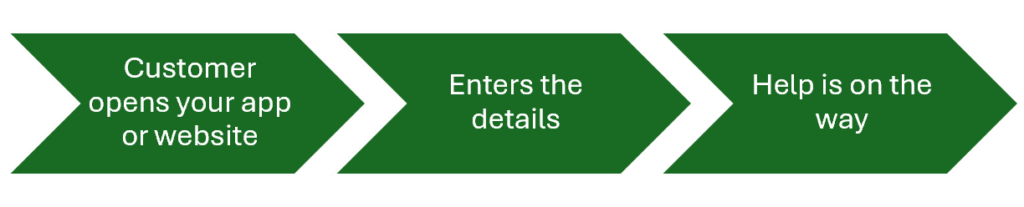
By simplifying the process through a single platform, your customers will appreciate how easy it was to get help when they needed it the most. The next time one of their friends asks for an insurance carrier’s recommendation, they’re more likely to suggest yours because this is the kind of experience that gets attention.
Bottom line
According to Agero1, 1 in 3 drivers in the US experiences a vehicle breakdown each year. Embedded roadside assistance benefits customers and carriers differently. For your customers, it means getting back on the road faster with less inconvenience. For insurance carriers, it means customer loyalty, better data, stronger brand presence, and a feature that customers actually notice and appreciate. In an industry where most interactions are invisible, this kind of visibility is rare and worth building around.
Learn how Way helps insurance carriers provide value with policyholders. See how it works.
Sources

