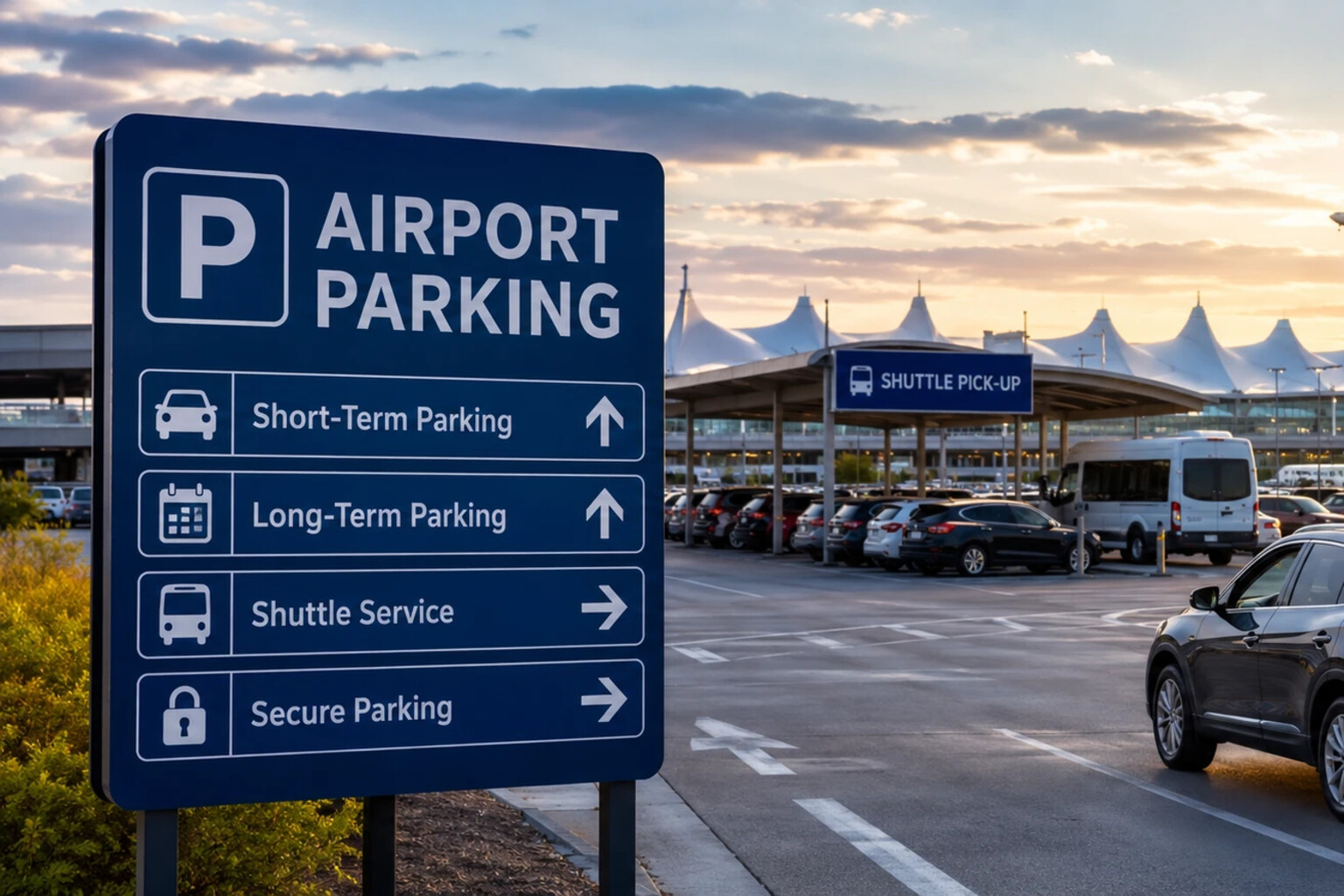
Most airport parking advice tells you which lot to pick. This is about the part nobody explains: what actually happens once you are there. Where you take a ticket, when you pay, how the shuttle works, what to do if you lose the ticket, and how not to spend twenty minutes hunting for your car at midnight.
None of how airport parking works is complicated. It is just unfamiliar, and unfamiliar at 5am with a flight to catch is how people end up stressed.
Key takeaways
- On-airport parking is generally drive-up and pay-on-exit. Off-airport usually expects a booking and a check-in.
- Payment is almost always taken when you leave, not when you arrive.
- Lose your ticket and the barrier still knows when you arrived — plate cameras handle it, usually at a flat or maximum rate.
- Add 30 to 45 minutes to your airport arrival plan if you are parking yourself, more if a shuttle is involved.
- Photograph your level, row or bay number. This is the single highest-value thing you can do in ten seconds.
The Options, Briefly
You will meet six categories: terminal or short-term, long-term, economy, off-airport, valet, and hotel park-and-fly. Each trades price against distance and transfer time.
This article is about mechanics rather than choice. If you have not settled on a tier yet, where to park at the airport compares all six, and the individual tiers are covered in short-term, long-term and economy parking. If you want to see live options and rates, Way’s airport parking search is the practical starting point.
How On-Airport Parking Works
You drive in, usually through a barrier. Depending on the facility you take a ticket, tap a card, or are simply photographed by a plate reader. Then you park, and you note where.
Paying. At most US airports payment happens on the way out, either at a pay station before you walk back to the car or at the exit barrier. Cards are accepted essentially everywhere; cash lanes still exist in places. Short-term facilities charge by the hour up to a daily maximum, which is the number worth finding before you commit.
Losing the ticket. Not a disaster. Plate cameras record your entry, so staff can establish when you arrived. Expect to pay a flat or maximum daily rate and to speak to an attendant with ID rather than to argue with a machine.
Grace periods. Many garages allow a few minutes free so you can enter, realise you are in the wrong place and leave again without paying. Do not rely on it as a strategy — the cameras are recording either way.
Covered against open. Garages shelter the car; surface lots do not. In hail, heavy snow or desert sun that difference is worth a modest premium, especially across a long trip.
Walk or ride. Terminal garages are usually walkable. Anything further out runs a shuttle, often every few minutes. The key detail is not the interval advertised but whether it holds at the hour you actually fly.
The headline: on-airport parking generally needs no reservation. You arrive, you park, you pay at the end — which is convenient, and part of why it costs more.
How Off-Airport Parking Works
Private facilities near the airport work more like a hotel than a car park.
- Book ahead. Most expect it and price accordingly; advance rates are usually below drive-up, and a booking guarantees a space.
- Check in. On arrival you present your confirmation at a booth, a kiosk or an app. The confirmation functions as your ticket.
- Park. Usually self-park in a marked area. Some sites take the keys and park it for you.
- Ride in. Head to the shuttle point. Services typically run continuously, and the interval is the thing to check.
- Come back. After baggage claim you call or use the app to request pickup, ride back, and collect the car.
The advantages are price and often amenities — covered bays, EV charging, a wash while you are away, staff on site. The costs are a little more time and a dependency on someone else’s shuttle. For an early departure, confirm the service runs at that hour rather than assuming round-the-clock.
Shuttles, and How to Plan Around Them
The shuttle is where parking plans usually go wrong, because travellers budget for the ride and forget the wait.
Before you book, find out how often it runs, how long the transfer takes, where it collects you at the terminal, whether it operates at your departure and arrival hours, and what happens if you land after midnight. A lot that saves a few dollars a day is not a saving if you are standing outside at 4am wondering whether a bus is coming.
On the return leg, look for ground transportation signage rather than the kerb you were dropped at — pickup points for parking shuttles are usually specific islands or numbered posts.
How Early to Arrive
There is no universal number. Work backwards:
- The time you want to be at the terminal.
- Drive time, with traffic.
- Finding the lot and a space, or checking in.
- Shuttle wait and ride.
- Walk from the drop-off to check-in.
- A buffer for the thing you did not plan for.
As a rule of thumb, add 30 to 45 minutes to your normal airport arrival time if you are parking rather than being dropped off, and more if a shuttle is involved. Check your airline’s or the airport’s guidance for how early to be there, and look at security wait times before you leave the house — parking gets you to the airport, not through it.
Waiting for an Arriving Passenger
If you are only collecting someone, do not sit at the kerb. Airports enforce stopping rules, and the dedicated answer is the cell phone waiting lot: a free holding area, usually minutes from the terminal, where you wait in the car until your passenger says they have their bags. Then you drive to the pickup area.
That is different from short-term parking, which is for actually leaving the vehicle and walking in — the case for meeting an international arrival, or helping someone through check-in. The distinction, and when each applies, is in what short-term parking is and when to use it.
Security and What to Leave in the Car
Airport lots are lit and patrolled, and many private sites add gates, fencing and cameras. That is not a reason to skip the basics, and being on airport property is not a guarantee.
- Take valuables with you, or lock them out of sight in the boot before you arrive rather than in the car park.
- Leave nothing visible on the seats.
- Close the windows, lock the car.
- If someone else will handle the vehicle, photograph its condition and keep the receipt.
- Note where you parked.
That last one sounds trivial until you are back at midnight on the wrong level of a garage. A photo of the row sign takes ten seconds.
EV Charging and Accessible Parking
Electric vehicles. Many airport garages now have chargers, and at some airports the electricity is included in the parking charge rather than billed separately. What varies is how many chargers exist, which connectors they support, whether you may stay parked once charged, and whether they can be reserved. Demand can exceed supply at busy times, so an EV bay is not a guaranteed charge. Confirm before relying on it.
Accessible parking. Accessible bays are required and are normally placed as close to terminals or shuttle stops as the site allows, usually first-come and without a reservation. If mobility is a real constraint, proximity is worth paying for, and it is worth checking whether a private lot offers accessible bays, step-free routes and a shuttle that can take a wheelchair before you book on price.
Things Travellers Get Wrong
- “I can just circle the terminal instead of paying.” Kerbside rules are enforced. Stopping is for unloading; waiting belongs in the cell phone lot.
- “Parking is always cheaper than a rideshare.” Often true for multi-day trips, where a fare each way is the comparison. Much less reliable for a single overnight, and it depends on your distance from the airport and the fuel you burn getting there. Do the sum for your own trip rather than trusting the generalisation.
- “Off-airport lots are dubious.” Reputable operators are licensed, fenced, monitored and reviewed. Judge the specific facility, not the category.
- “There will be a space.” Terminal garages fill at peak times, and popular private lots sell out. A reservation is cheap insurance around holidays.
- “Parking sorted means I am fine.” Parking gets you to the airport. Security is still ahead of you.
Frequently Asked Questions
Do I need to reserve airport parking?
Not usually for on-airport lots, which are built for drive-up and payment on exit. Off-airport facilities generally expect a booking, and advance rates are often better. At holidays, reserve either way.
When do I pay?
Almost always on the way out, at a pay station or the exit barrier. Off-airport sites typically take payment at booking instead.
What if I lose my ticket?
Plate cameras record your entry, so the time is known. Expect a flat or maximum daily charge and to speak to an attendant with ID.
Can I park overnight?
Yes in long-term and economy lots, which are designed for it. Short-term facilities often discourage or prohibit it, and charge accordingly.
Where do I wait to collect someone?
The cell phone waiting lot. It is free, close, and exists precisely so drivers are not idling at the kerb.
Are taxes and fees added to the posted rate?
At many airports the posted rate is what you pay, but that is not universal and private operators may add fees or charge extra for oversized vehicles. Check the total at booking rather than assuming.
Does EV charging cost extra?
Sometimes it is included in the parking charge and sometimes billed separately — it depends on the airport and the operator. Availability and connector type vary too, so confirm before depending on it.
How long can I leave my car?
Long-term and economy lots commonly cap at around 30 to 45 days, after which a vehicle can be treated as abandoned. For longer, arrange it with the airport or operator in advance.
Your Trip Starts Before the Terminal
Airport parking stops being stressful once you know the shape of it: pick a tier, book if the lot expects it, arrive with 30 to 45 minutes of slack, pay on the way out, and photograph where you left the car.
The details that actually change your morning are the dull ones — shuttle frequency, operating hours, the daily maximum, the cancellation terms. Check those for your dates rather than trusting a rate you read somewhere, and the parking becomes the easiest part of the journey instead of the first problem.
Get 10% off in the Way App in the Way App!

- Scan and get the Way App Download the Way App
- Log in to your account
- Use code FIRST10 at checkout