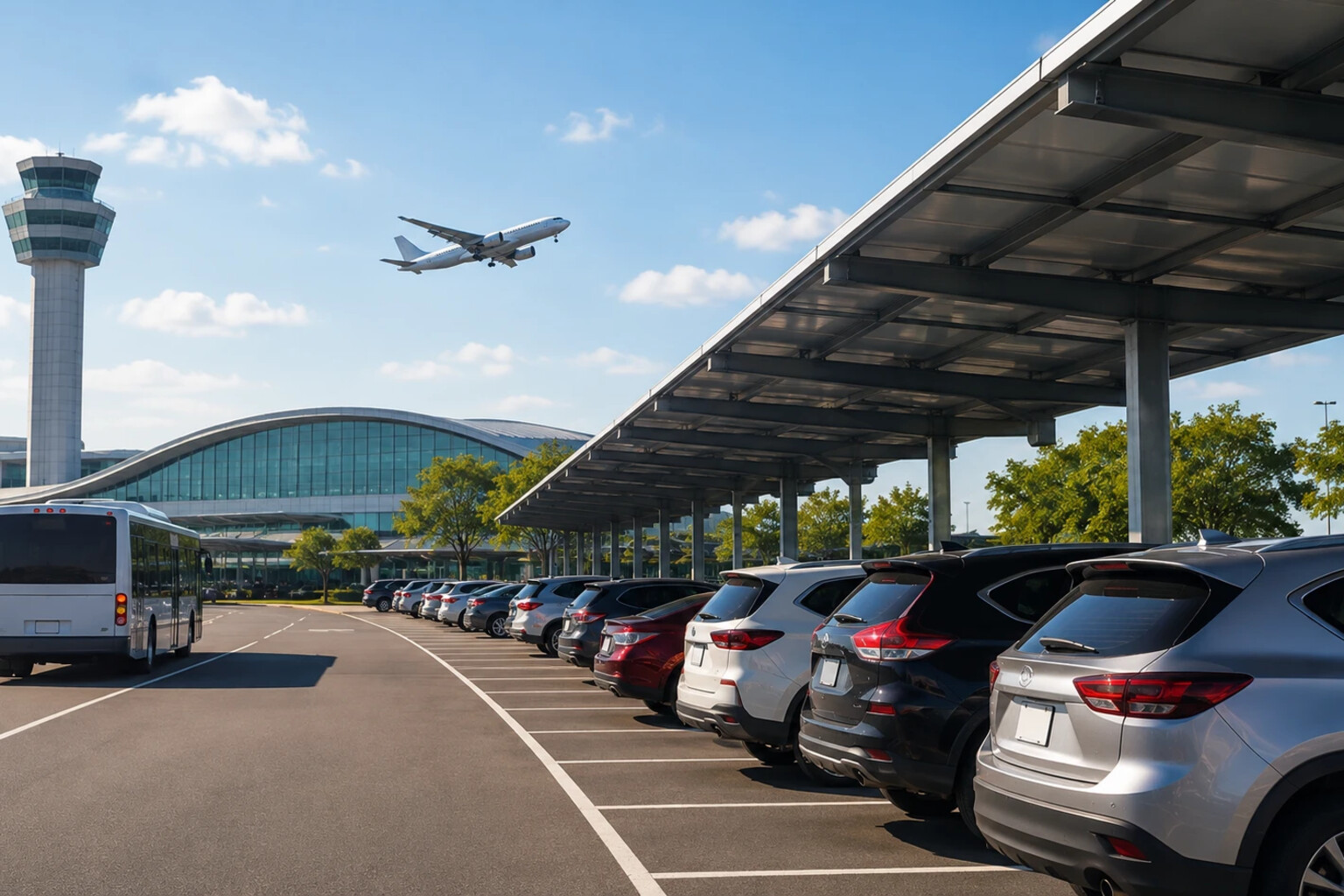
Long-term parking is the category built for leaving a car behind rather than using it. Where short-term parking sells a short walk, long-term sells a lower daily rate across several days — and for most holidays, business trips and cruises, that is the trade worth making.
The definition is simple enough: parking intended for stays beyond a day, priced as a flat daily rate that falls well below hourly terminal pricing once you are past the first twenty-four hours.
Key takeaways
- Long-term parking means multi-day parking, typically anything beyond about a day.
- Most airports state plainly that short-term lots are not intended for overnight stays. Use long-term or economy instead.
- It exists both on airport property and off it. Off-airport is often cheaper; on-airport is usually simpler.
- Almost all long-term lots have a maximum stay, commonly around 30 to 45 days. Past that a car can be treated as abandoned.
- Judge the shuttle, not just the rate — frequency, hours and where it drops you.
Long-Term Against Short-Term
They exist for different jobs, which is why they are priced differently.
Short-term covers brief visits: collections, drop-offs, a quick errand inside the terminal. It sits closest to the terminals and charges by the hour, often with a daily maximum that becomes punishing across a multi-day stay.
Long-term covers extended stays. It is further out — sometimes a longer walk, more often a shuttle or train — and charges a flat daily rate designed for people who will not touch the car for a week.
The practical point is the one airports themselves make: short-term lots are generally not intended for overnight parking. If the car is staying the night, or several, the long-term or economy tier is the one you want. The other side of that comparison is in what short-term parking is and when to use it.
Who Actually Uses It
- Holidaymakers. A week away, a cruise, a spring break — the car sits still and the daily rate is what matters.
- Business travellers on multi-day trips, including the ones that end on a red-eye.
- International travellers, where trips routinely run past a week.
- Cruise passengers flying to a port and returning to the same airport.
- Students and seasonal workers leaving a car for weeks at a time.
- Anyone on temporary duty or an extended absence, subject to the maximum-stay rules below.
Put simply: if you will be away more than a day, this is the tier to look at first. If you are collecting someone or dropping them off, it is the wrong one.
On-Airport Against Off-Airport
On-airport long-term lots are run by the airport. They are usually surface lots or garages set back from the terminals, with an airport shuttle or train connecting them. You get integration — airport signage, airport shuttles, one operator — and generally pay more per day than you would off site.
Off-airport lots are private facilities near the airport, connected by their own shuttle. Because operators compete for bookings, rates are often meaningfully lower, and many differentiate on amenities: covered bays, car washes, loyalty schemes, staffed gates. The trade is that you depend on their shuttle and their hours.
Hotel park-and-fly sits alongside both: an airport-area hotel bundling a night’s stay with parking, which can work out well if you wanted the room anyway and much less well if you did not.
Choosing between them comes down to what you are optimising. Proximity and simplicity point on-airport. Price points off-airport, provided you have checked the shuttle. Either way, compare for your actual dates rather than a remembered rate.
Covered Parking and Amenities
Long-term lots are often open-air, which matters more than it sounds when a car will sit for two weeks. Covered parking protects against hail, snow, sun and UV, and in places with real weather that protection is worth a modest premium — particularly for a newer vehicle or a longer absence.
Off-airport and hotel facilities frequently offer things airport lots do not:
- Frequent shuttles, often running around the clock.
- Security features — gated entry, fencing, lighting, cameras, staff on site.
- Vehicle services such as jump starts, tyre inflation, or a wash while you are away.
- Valet or indoor options at the premium end.
- EV charging, increasingly common in garages.
Airport lots are patrolled, but that is not a reason to skip the basics: lock the car, take valuables with you, and leave nothing visible on the seats.
What It Costs
Long-term rates vary widely by airport and change over time, so a specific number quoted in an article is worth very little by the time you read it. What holds is the relationship:
- Terminal and short-term parking is the most expensive per day.
- Long-term is materially cheaper per day than short-term.
- Economy, where an airport offers it, is usually the cheapest tier still on airport property.
- Off-airport can undercut all of them, at the cost of a private shuttle.
Some airports also taper the rate — a slightly lower daily charge after the first few days — and some private lots run multi-day deals. Both are worth looking for, and neither is universal.
For current figures, use the airport’s own parking page and search your dates. You can compare what is actually available on Way, including at Denver and via Denver parking listings.
Maximum Stays
This is the rule that catches people out, and it is worth stating clearly: most long-term lots cap the stay, commonly somewhere around 30 to 45 days. Leave a vehicle beyond the limit without arranging it and it can be treated as abandoned and towed.
If your trip genuinely runs longer than a month, that is a conversation to have in advance with the airport or the lot operator, or a reason to look at monthly parking or vehicle storage instead of a standard long-term booking.
Booking and Saving
- Book ahead. Advance rates are frequently better than drive-up, and at busy periods a reservation is the difference between a space and a problem.
- Compare on-airport against off-airport. Do not assume the airport’s own lot is cheapest, or that a private lot is.
- Look for discounts — membership schemes, loyalty programmes, promotional rates.
- Check the shuttle before the price. Frequency, operating hours, and whether it runs at the hour you land.
- Read the cancellation terms. A flexible booking is worth a little more when a return flight might move.
- Book early in peak season. Long-term lots do fill up around holidays.
Common Mistakes
- Treating all airport parking as interchangeable. Leaving a car overnight in a short-term garage is how people end up with a bill they did not expect.
- Assuming any lot allows overnight stays. Many explicitly do not.
- Assuming a month is fine. Check the maximum stay before you go, not after.
- Skipping the reservation. Drive-up works until the holiday weekend when it does not.
- Dismissing off-airport as dubious. Reputable operators are fenced, lit, staffed and reviewed. Judge the specific facility.
- Ignoring the weather. Two weeks of hail or desert sun is a real cost to an uncovered car.
- Assuming “economy” means the same thing everywhere. It is a label, and each airport applies it differently.
Frequently Asked Questions
Is long-term parking cheaper than short-term?
Per day, for a multi-day trip, yes. Short-term is priced hourly for proximity; long-term is priced flat for duration. The gap compounds across a week.
Can I park overnight in long-term parking?
Yes — that is what it is for. It is short-term lots that often prohibit or discourage overnight stays.
How far is it from the terminal?
It varies. On-airport long-term is typically a short shuttle or train ride. Off-airport can be a mile or several, with the operator’s own shuttle. Check the transfer time, not just the distance.
Should I reserve or just drive up?
Reserve where you can. It usually unlocks a better rate and always removes the risk of arriving at a full lot, which matters most in peak season.
Do all long-term lots have shuttles?
Most do, but confirm it. Some on-airport lots connect by walkway or train instead, and private lots vary in frequency and operating hours.
Is my car safe?
Generally. These lots are typically fenced, lit and patrolled, and many private operators advertise cameras and on-site staff. Still lock the car and take valuables with you.
What is economy parking, then?
Usually the cheapest long-term tier still on airport property — the furthest lot with the lowest rate. Economy parking covers how it differs and when it fits.
What if I need to leave the car for two months?
Arrange it in advance. Standard long-term bookings usually cap at around 30 to 45 days, and beyond that you want monthly parking or storage rather than a regular reservation.
Where This Leaves You
Long-term parking is simply parking for people leaving a car for days rather than hours. It is cheaper per day than short-term, usually needs a shuttle, and is the right default for holidays, cruises and multi-day business travel.
Pick between on-airport and off-airport on what you are optimising: simplicity or price. Check the shuttle, check the maximum stay, book ahead, and consider covered parking if the weather where you fly from is unkind. If you would rather see all the options side by side first, where to park at the airport lays them out.
Get 10% off in the Way App in the Way App!

- Scan and get the Way App Download the Way App
- Log in to your account
- Use code FIRST10 at checkout