Auto repair shop reviews: 3 reasons they matter more than you think
Reviews shape whether drivers trust your shop before they ever walk in. Learn three reasons they matter more than most auto repair shops think, and how the way you reply can win or lose customers.
October 13, 2026 · Eric BucknerLinkedIn profile of Eric Buckner · 9 minutes read

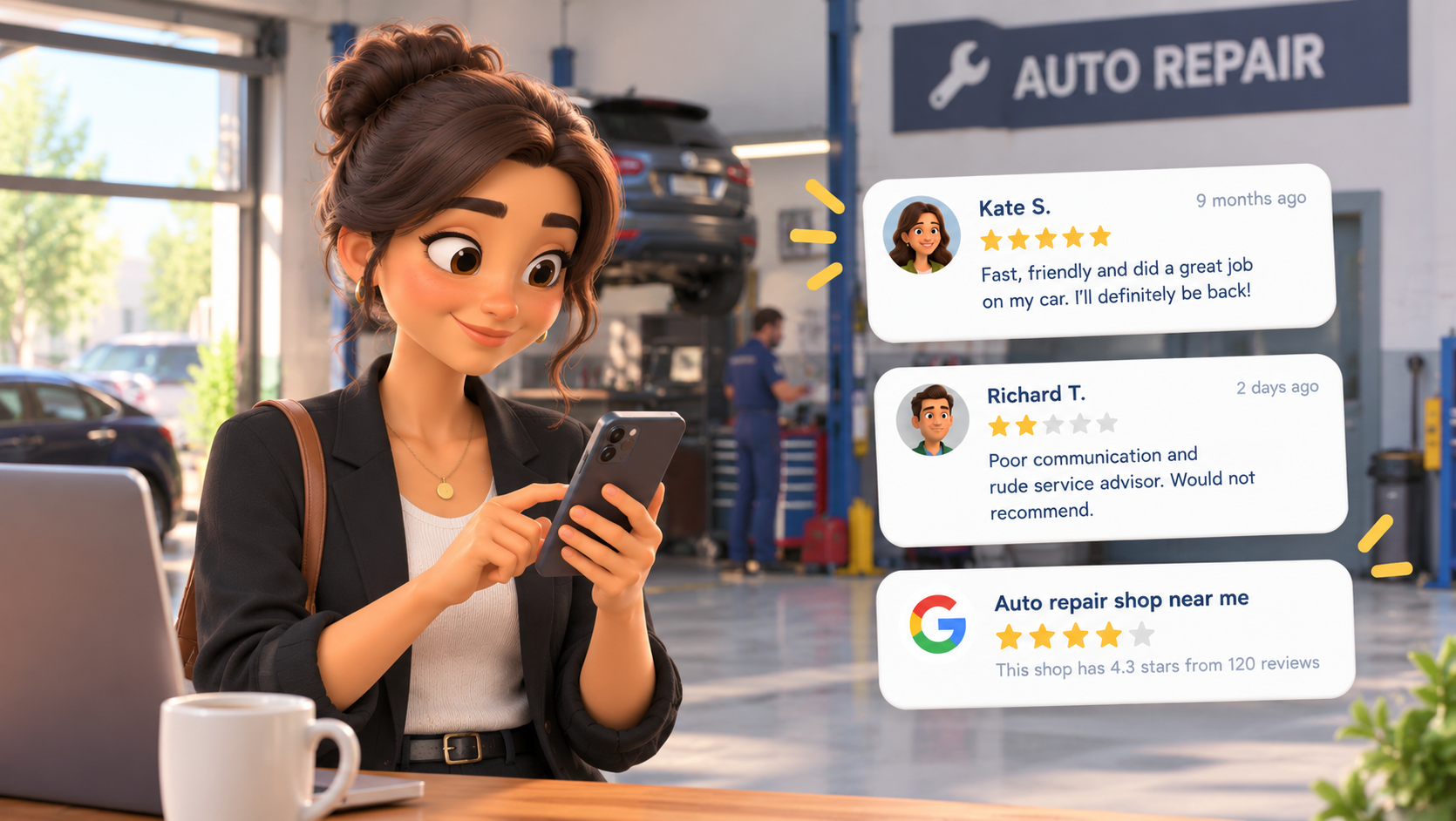
Kate visited your auto repair shop nine months ago and raved online about how efficient and meticulous the service was. With such a great review, leaving a reply was a no-brainer. You thanked her for the review, inviting her to drop by the next time she has trouble with her car. She is now one of your regular customers.
Richard came by your shop two days ago and left a two-star rating with a long paragraph criticizing the way your service advisor handled the repair. Disgruntled by the review, you decided you shouldn’t dignify it with a response.
Now, when a customer searches for “auto repair shop near me” online and comes across yours today, they’re going to see the scathing review that Richard left with no reply. Sure, they might scroll down and read the one Kate wrote, but at nine months old, it may not carry much weight. According to BrightLocal, 74% of consumers only care about reviews written in the last three months. And it only gets worse: an unanswered bad review can make a potential customer skeptical about visiting your shop, and 42% of consumers say they’re unlikely to use a business that never responds to reviews.
Many shop owners treat reviews as an afterthought. Reviews can take your shop from “the trusted go-to” to “never visit again” pretty quickly, and a lot of it comes down to psychology. With 97% of people leaning on reviews for local businesses, here are three reasons reviews can make or break your shop.
Reason 1: Reviews build trust way before the first visit
When Kate’s car was making noise nine months ago, she searched for shops nearby. She wasn’t just thinking about whether the shop was any good. She was thinking, “Is this shop going to give the right diagnosis and charge me fairly?”
In service businesses such as repair shops, customers can’t really judge the quality of your work themselves, so they tend to lean on other people’s experiences before they make any decision. For a driver unsure whether a shop will do the job right, reviews are social proof that someone else took the same risk, and it worked out. Nearly half of consumers (49%) trust online reviews as much as they would a recommendation from family or friends, according to the same BrightLocal survey.
Psychologists have found that people are often surprisingly bad at guessing how they’ll feel about future experiences. This process is known as affective forecasting. What works better is hearing from someone who has been through it. In a 2009 study published in Science, people predicted how they’d feel about a future event more accurately when they knew how another person had reacted to it than when they were given details about the event itself, even though they believed the opposite. That’s what a review is: another person’s experience of the same thing, which is why reviews matter.
A specific review tends to be more reassuring than a generic one. “Great service, 100% recommend” leaves a lot to the imagination.
On the other hand, consider a review like this: “Went in thinking it was an engine issue; the service advisor and tech figured out it was actually a loose belt and fixed it within a few hours. They explained the entire process through visuals, and I was able to understand it quite well. Other shops I’ve gone to end up charging more for the same thing, so I was pleasantly surprised at the final bill. This is going to be my regular shop from now on.”
Notice the difference? It addresses the fears that many first-time customers might have, like miscommunication and overcharging. A September 2026 analysis by consulting firm Sales Roadmap of 12,884 one- and two-star Google reviews of auto repair shops found that 48.9% raised at least one complaint about money, like an unclear price or work done without the customer’s approval.
Timing matters too, since customers remember more specifics when the experience is fresh. Your employees at the counter should know when to request a review, and they should ask every customer. At pickup, start by asking customers how they felt about the service, and then gently invite them to leave a review without hovering. One reviewer in that analysis complained about staff standing over their shoulder to make sure they left a Google review. Skip pressure tactics like that, and follow up with a text a day later: “Hey [Customer Name], checking in to see how your car’s doing. When you get the time, please do leave us an honest review!”
Reason 2: Bad reviews tend to weigh more heavily than good ones
A potential customer who sees Richard’s recent review may become slightly wary of your shop even before visiting it because people tend to give more weight to a negative experience than a positive one. It’s called negativity bias: a widely cited 2001 paper by Roy Baumeister and colleagues found that bad impressions form faster and are harder to undo than good ones. It shows up in reviews, too. In a 2016 Pew Research Center survey, 54% of people who read online reviews said they pay more attention to extremely negative ones, compared with 43% who pay more attention to extremely positive ones.
The good news is that you don’t need every rating to be five stars. A study by Northwestern’s Spiegel Research Center looked at shopping data across more than 40 product categories and found that people are most likely to buy products rated between 4.2 and 4.5 stars. Interestingly, as a product’s rating approaches a perfect five stars, the likelihood of a purchase drops. The same analysis cites PowerReviews research showing that 82% of shoppers look for negative reviews before making a purchase. These findings are based on retail, not auto repair shops, but they suggest that a few less-than-perfect reviews can make your positive reviews feel more genuine and trustworthy. Negative reviews are also a small share: in the Sales Roadmap analysis, one- and two-star reviews made up 7.8% of the reviews held by the shops studied, while 86.7% were five-star.
A shop with a steady flow of fresh reviews also looks busy, and that triggers the bandwagon effect: we tend to follow where others are going. According to BrightLocal, 47% of consumers won’t use a business that has fewer than 20 reviews.
But reviews aren’t the only thing customers see. They are looking at how you respond as well, and in the case of Richard, the lack thereof. If you had replied to Richard’s review, customers searching for your shop would’ve seen how you deal with those who complain and realized that real people are behind the business. You’re not only replying to Richard; you’re also replying to every future customer.
BrightLocal also found that 89% of consumers expect businesses to respond to reviews, and 80% say they’re likely to use a business that responds to all of them.
So, start replying to every review, whether good, bad, or neutral, within a day or two, since 19% of people expect a reply the same day and 32% expect one by the following day. If you write back to Richard now, it could go something like this: “Hi Richard, thank you for letting us know. We’re sorry; we realize we could’ve communicated better. If it’s all right with you, would you consider coming into the shop? We can look at your car once again. Do let us know by contacting the shop at this number: (phone number). – [Your Name], Owner”
Reason 3: Reviews show what your customers actually feel
Not everyone bothers to leave a review. Customers who do leave a review often want to either show that your shop can be trusted or warn others. In BrightLocal’s survey, 69% of consumers wrote a review in the past year, but only 29% wrote about a negative experience, compared with 60% for a positive one.
So what are customers actually complaining about? The Sales Roadmap analysis found that 87.5% of negative reviews described a failure in how the shop was run. Staff conduct was the most common complaint (38.6%), followed by diagnostic accuracy (33.7%), workmanship (32.2%), and pricing transparency (31.7%). Richard’s complaint about how your service advisor handled the repair falls under the most common category.
If you see a pattern in the negative comments, you know you have to fix the underlying issue ASAP. For example, if three customers have mentioned that they waited too long for a callback, you have a problem that your future customers will figure out too. BrightLocal found that the most important factor in how consumers judge a review is whether other reviews back it up with similar sentiment (56%).
Once a month, go through your recent reviews and write down two topics: the one customers praise most and the one they criticize most. You can keep up the first and work on the second.
Conclusion
As an auto repair shop owner, you might be under the impression that auto repair shop reviews don’t matter as much as they do for a clothing brand. But BrightLocal’s 2023 survey ranked automotive services among the top three industries where consumers see reviews as most important. Reviews from customers like Kate and Richard can help you improve your operations, and how you respond to them can help you win more loyal customers or lose the ones who would have walked in. Had you replied to Richard, the next driver who found your shop would have seen an owner who listens.