A technician’s guide to code P0420
P0420 looks like a simple “replace the cat” job, but misfires, exhaust leaks, and lazy sensors can set the same code. This guide walks new techs through how to prove the fault, find the root cause, and explain the repair to the customer.
October 16, 2026 · Arnold GoldLinkedIn profile of Arnold Gold · 6 minutes read

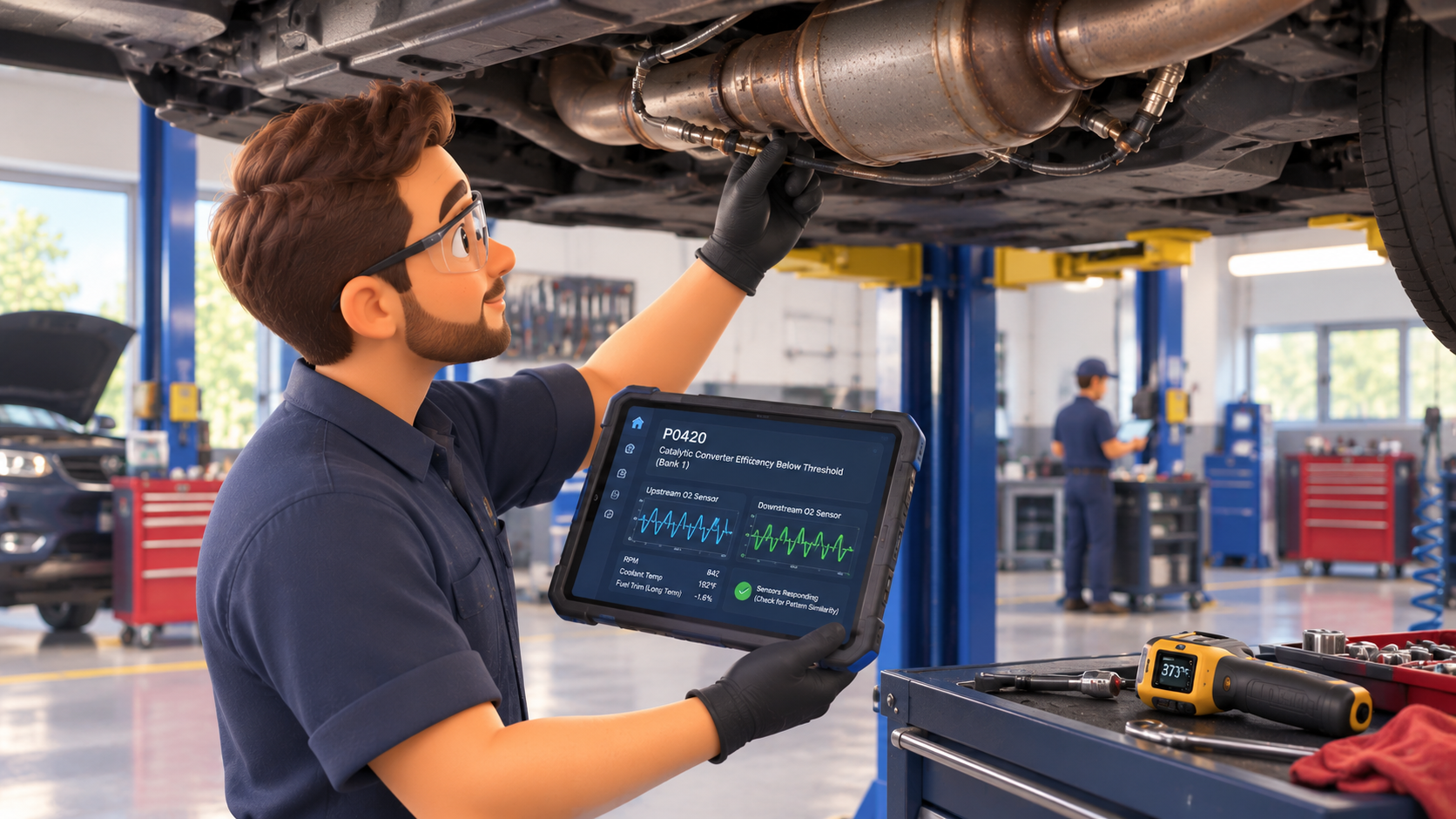
Code P0420 means that the catalytic system efficiency is below the threshold (Bank 1). When a customer brings in their car with this code, however, it doesn’t always mean that their catalytic converter needs replacing.
Misfires, exhaust leaks, fuel control problems, and lazy downstream sensors can all set off the same code. If you replace the converter without knowing the actual cause, you’re looking at a comeback, an unhappy customer, and a warranty claim on a part that was probably not the problem.
What does code P0420 mean?
The Engine Control Module (ECM) judges the catalyst health by comparing the upstream and downstream oxygen sensors on Bank 1. A healthy converter stores and releases oxygen, so the downstream signal stays fairly calm while the upstream sensor flips back and forth. As the converter wears out, the downstream signal starts copying the upstream one. Once the ECM’s calculated efficiency falls below its threshold, it sets the code P0420.
Bank 1 is the side of the engine that contains cylinder number 1. The downstream oxygen sensor is usually labeled B1S2. P0430 indicates the same type of problem on Bank 2.
What are some of the common causes of P0420?
- Other stored codes: misfire (P0300 series), fuel trim (P0171/P0174), coolant temperature (P0125/P0128)
- Exhaust leaks upstream of the downstream sensor
- Wiring, connector, or sensor faults on the oxygen sensors
- Worn spark plugs, failing ignition coils, or leaking fuel injectors can all cause misfires that affect catalyst performance.
- Excessive fuel pressure, vacuum leaks, or contaminated fuel can upset the air-fuel mixture.
- Oil or coolant reaching the exhaust, such as burning oil or a failing head gasket
- A faulty ECT sensor or thermostat that keeps the engine out of closed loop
- A converter at the end of its life from age, mileage, or heat damage
Check these before you replace the cat
Before you start quoting your customer for a brand-new catalytic converter, run a few basic checks. They’re fairly quick and can trigger the code on their own or make a good cat look bad.
- Scan for other codes. Misfire, fuel trim, and coolant temperature codes get fixed first. If your tool supports Mode 06, check the catalyst monitor result to see how close the converter is to the threshold.
- Inspect the exhaust and look for leaks at the manifold, flex pipe, flange gaskets, and anywhere upstream of the downstream sensor. A leak lets outside air in and skews the oxygen readings. A smoke machine is the fastest way to find one. Low-pressure air with the tailpipe plugged, and some soapy water also works.
- Check the sensor wiring and connectors. You need to make sure there isn’t any chafing, heat damage, or corrosion at the connector.
- Check if the car manufacturer released a software update (Technical Service Bulletin) that fixes false computer warnings about the converter.

How to tell if the converter is actually bad
To check if the cat is the problem, you’ll need a scan tool with live data graphing, a smoke machine, an infrared thermometer, and a pressure or vacuum gauge.
1. Check fuel trims and misfire counters
You’ll need to warm up the engine and check the fuel trims and available misfire counters with your scan tool.
If the engine is running too rich or too lean, fix that problem before condemning the converter. An unresolved fueling issue can damage a replacement converter, too. If you suspect a cylinder-specific problem, run a power balance test or examine the ignition pattern with a scope.
2. Compare the upstream and downstream oxygen sensors
Graph both oxygen sensor signals and watch how they behave under the conditions specified by the manufacturer.
When checking the narrowband sensor, the upstream signal typically switches between roughly 0.1 and 0.9 volts. A wideband sensor works differently, so you should monitor its lambda or air-fuel ratio reading instead. The downstream sensor should generally show less fluctuation because the converter smooths out changes in the exhaust gases.
3. Run a snap-throttle and decel test
Rev the engine up and quickly let off the gas. A healthy rear sensor will react quickly and then drop down on decel fuel cut, and recover slowly. If it’s slow to respond, the sensor may be your problem and not the cat. Don’t skip this step.
4. Check the difference in temperature
Use an infrared thermometer to measure the exhaust pipe right before and right after the converter. The outlet pipe should be at least 100°F hotter than the inlet pipe. If it’s cooler or the same, the converter isn’t working.
5. Backpressure test
If your customer complains that the car has lost its power, check whether the catalytic converter is restricted. A converter can be inefficient without being blocked, so this test is particularly useful when you suspect an exhaust restriction.
Connect a suitable pressure gauge to an upstream oxygen sensor port, or use a vacuum gauge at the intake manifold to look for signs of restricted exhaust flow.
Compare the readings with the vehicle manufacturer’s specifications. As a general reference, backpressure is often expected to remain around 1.5 psi or less at idle and roughly 3 psi or less at 2,500 rpm, but acceptable limits vary by vehicle.
Fixing code P0420
Check if any other codes have come up besides code P0420.
Replace the gaskets, tighten the fasteners, or cut out the damaged section and join new pipe with clamps or a weld.
Replace the rear oxygen sensor if the snap test proves it is slow and worn out, rather than replacing the whole converter.
Check plug type, gap, and condition against the OEM spec. Iridium plugs often last 80,000 miles or more, but a cheaper plug swapped into an iridium application may wear much sooner. Then check the coils and injectors.
Update the calibration if there’s a TSB for the catalyst monitor. This usually needs OEM software or a J2534 pass-thru tool.
Replace the converter only after your testing says it’s done. In states following California Air Resources Board (CARB) rules, use a CARB-certified catalytic converter with a stamped executive order (EO) number. In other states, ask your customer if they want an aftermarket choice or the original equipment manufacturer (OEM).
Quick answers
-
Can code P0420 clear itself?
The light usually goes out after a few clean drive cycles. Clearing the code with a scan tool resets the readiness monitors, so the car won’t be ready for an emissions test until they run again.
-
Is it safe to keep driving?
Usually, yes. On its own, P0420 is an emissions problem, not a safety one. But if it comes with misfires, a lean condition, or a loss of power, tell the customer to get it in soon, because those can damage the engine and the converter.
-
Will a cat cleaner fix it?
Catalytic cleaners rarely bring back a failing converter. Test first, and don’t offer a cleaner as a substitute for diagnosis.