Engine serial number search: How to find the engine number on 15 common engines
Ordered a part off the VIN and it didn’t fit? The engine serial number tells you which version of the engine is under the hood. Here is where to find it on 15 common Honda, Kia, and Toyota engines, and what to do when the stamp is worn.
October 23, 2026 · Eric BucknerLinkedIn profile of Eric Buckner · 11 minutes read


Have you ever ordered a part using your customer’s VIN, waited a couple of days for it to arrive, and then watched with dismay as it refused to go on? It’s happened to the best of us, and telling the customer they need to wait another day is never fun. The VIN tells you which car you’re working on, but not always the exact engine version under the hood. This guide explains where to find the number stamped on the engine and how an engine serial number search can help you avoid placing yet another parts order.
How many engine numbers are there?
There are 4 types of engine numbers, which is probably why they can get a little mixed up now and then. We’re listing them out so there’s no confusion.
- Engine serial number: This is unique to that one engine, typically has 7 to 17 characters (numbers and letters), and this is what we’ll get into more detail about later on.
- Engine ID: This one’s a tag or a label number that describes how that engine was built. Ford diesels have a 7-digit engine ID, which is why people can sometimes confuse that for an engine serial number.
- Casting number: This belongs to the block casting these engines and is shared by several thousand of them. It therefore should not be used to identify the engine, even if it is raised and easy to read.
- Engine code: Not to be confused with the Diagnostic Trouble Code (DTC), this is an engine identification code that defines the physical build of the motor. This can also be used for ordering correct replacement parts (gaskets, timing belts, spark plugs).
What is the difference between an engine code and an engine serial number?
Think of your phone for a second. When someone says they have an iPhone 16 Pro Max, you know exactly what kind of phone it is (the screen, the camera, the storage options), but so do about a few million other people, because they all have the very same model. The IMEI number, on the other hand, belongs to your phone and nobody else’s. Engines work pretty much the same way!
The engine code is the model name of the engine, like 2GR-FE. It tells you the family, the displacement, and how the engine is built, and it is shared by every engine of that type, which is why it’s the thing you use to narrow down parts. The engine serial number is the one that belongs to the single engine in front of you, and nobody else’s engine has the same one.
| Engine code | Engine serial number | |
| What it is | The model or family name of the engine | A sequence number given to that one engine |
| Is it unique? | No, a lot of cars share the same code | Yes, no two engines from the same maker get the same number |
| What it tells you | The engine’s basic specs (size, cylinders, fuel type) | The individual engine, and on some makes, where and when it was built |
| What you use it for | Narrowing down the right parts family | Telling similar versions apart, checking recalls and keeping a record on the repair order |
On a Toyota, the two even show up together, because the serial number starts with the engine code (2GR, then a hyphen, then a plant code from 1 to 9, then six digits). So the code gets you to the right family, and the serial number gets you to the right engine within it.
How to use this guide
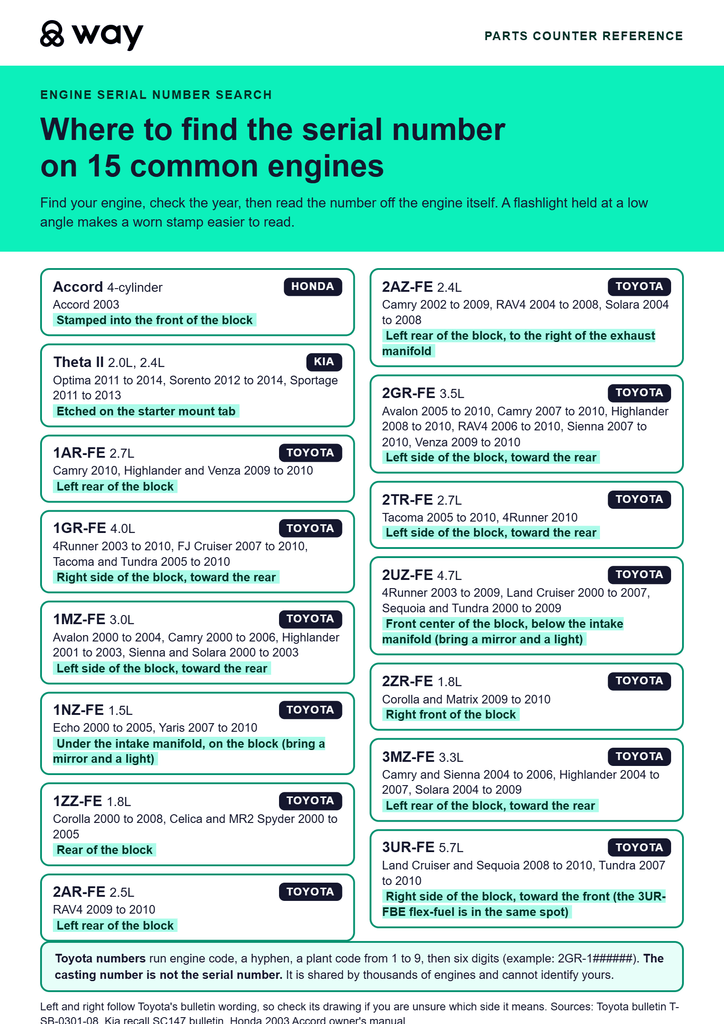
Find your engine in the list, check the year range (several engines went into many models, so the years matter), and follow the description to the spot. Each entry has the same eight lines so that you can skim. Hold a flashlight flat against the block and a worn stamp becomes readable.
The 15 engines
Honda
Honda Accord 4-cylinder
- Years: 2003 (from Honda’s owner’s manual for that year)
- Where the number is stamped: into the block, on the front
- What’s in the way: nothing noted in the manual
- What it looks like: the manual doesn’t describe the format
- What it tells you: which exact engine you have, for parts that differ inside the family
Kia
Kia Theta II 2.0L and 2.4L
- Years: Optima 2011 to 2014, Sorento 2012 to 2014, Sportage 2011 to 2013
- Where the number is stamped: etched on the starter mount tab
- What’s in the way: the starter and its wiring
- What it looks like: the bulletin doesn’t describe the format
- What it tells you: whether your engine is in the recall (dealers order recall engines through the dealer system with an affected VIN)
Toyota
Toyota’s bulletin says “left” and “right” without saying whether you look from the driver’s seat or the front of the engine, so check its drawing the first time you use any of these.
Toyota 1AR-FE 2.7L
- Years: Camry 2010, Highlander and Venza 2009 to 2010
- Where the number is stamped: left rear of the block
- What’s in the way: nothing noted in the bulletin
- What it looks like: 1AR, a hyphen, a plant code from 1 to 9, then six digits
- What it tells you: the engine family and the plant it came from
Toyota 1GR-FE 4.0L
- Years: 4Runner 2003 to 2010, FJ Cruiser 2007 to 2010, Tacoma and Tundra 2005 to 2010
- Where the number is stamped: right side of the block, toward the rear
- What’s in the way: nothing noted in the bulletin
- What it looks like: 1GR, a hyphen, a plant code from 1 to 9, then six digits
- What it tells you: the engine family and the plant it came from
Toyota 1MZ-FE 3.0L
- Years: Avalon 2000 to 2004, Camry 2000 to 2006, Highlander 2001 to 2003, Sienna and Solara 2000 to 2003
- Where the number is stamped: left side of the block, toward the rear
- What’s in the way: nothing noted in the bulletin
- What it looks like: 1MZ, a hyphen, a plant code from 1 to 9, then six digits
- What it tells you: the engine family and the plant it came from
Toyota 1NZ-FE 1.5L
- Years: Echo 2000 to 2005, Yaris 2007 to 2010
- Where the number is stamped: under the intake manifold, on the block
- What’s in the way: the intake manifold, so bring a mirror and a light
- What it looks like: 1NZ, a hyphen, a plant code from 1 to 9, then six digits
- What it tells you: the engine family and the plant it came from
Toyota 1ZZ-FE 1.8L
- Years: Corolla 2000 to 2008, Celica and MR2 Spyder 2000 to 2005
- Where the number is stamped: rear of the block
- What’s in the way: nothing noted in the bulletin
- What it looks like: 1ZZ, a hyphen, a plant code from 1 to 9, then six digits
- What it tells you: the engine family and the plant it came from
Toyota 2AR-FE 2.5L
- Years: RAV4 2009 to 2010
- Where the number is stamped: left rear of the block
- What’s in the way: nothing noted in the bulletin
- What it looks like: 2AR, a hyphen, a plant code from 1 to 9, then six digits
- What it tells you: the engine family and the plant it came from
Toyota 2AZ-FE 2.4L
- Years: Camry 2002 to 2009, RAV4 2004 to 2008, Solara 2004 to 2008
- Where the number is stamped: left rear of the block, to the right of the exhaust manifold
- What’s in the way: the exhaust manifold, which runs hot, so let it cool first
- What it looks like: 2AZ, a hyphen, a plant code from 1 to 9, then six digits
- What it tells you: the engine family and the plant it came from
Toyota 2GR-FE 3.5L
- Years: Avalon 2005 to 2010, Camry 2007 to 2010, Highlander 2008 to 2010, RAV4 2006 to 2010, Sienna 2007 to 2010, Venza 2009 to 2010
- Where the number is stamped: left side of the block, toward the rear
- What’s in the way: nothing noted in the bulletin
- What it looks like: 2GR, a hyphen, a plant code from 1 to 9, then six digits
- What it tells you: the engine family and the plant it came from
Toyota 2TR-FE 2.7L
- Years: Tacoma 2005 to 2010, 4Runner 2010
- Where the number is stamped: left side of the block, toward the rear
- What’s in the way: nothing noted in the bulletin
- What it looks like: 2TR, a hyphen, a plant code from 1 to 9, then six digits
- What it tells you: the engine family and the plant it came from
Toyota 2UZ-FE 4.7L
- Years: 4Runner 2003 to 2009, Land Cruiser 2000 to 2007, Sequoia and Tundra 2000 to 2009
- Where the number is stamped: front center of the block, below the intake manifold
- What’s in the way: the intake manifold, so bring a mirror and a light
- What it looks like: 2UZ, a hyphen, a plant code from 1 to 9, then six digits
- What it tells you: the engine family and the plant it came from
Toyota 2ZR-FE 1.8L
- Years: Corolla and Matrix 2009 to 2010
- Where the number is stamped: right front of the block
- What’s in the way: nothing noted in the bulletin
- What it looks like: 2ZR, a hyphen, a plant code from 1 to 9, then six digits
- What it tells you: the engine family and the plant it came from
Toyota 3MZ-FE 3.3L
- Years: Camry and Sienna 2004 to 2006, Highlander 2004 to 2007, Solara 2004 to 2009
- Where the number is stamped: left rear of the block, toward the rear of the engine
- What’s in the way: nothing noted in the bulletin
- What it looks like: 3MZ, a hyphen, a plant code from 1 to 9, then six digits
- What it tells you: the engine family and the plant it came from
Toyota 3UR-FE 5.7L
- Years: Land Cruiser and Sequoia 2008 to 2010, Tundra 2007 to 2010
- Where the number is stamped: right side of the block, toward the front
- What’s in the way: nothing noted in the bulletin
- What it looks like: 3UR, a hyphen, a plant code from 1 to 9, then six digits
- What it tells you: the engine family and the plant it came from
What does the serial number tell you about the part you need?
Here is the case that changes the part you order. An engine can change partway through a model year, and the VIN won’t always tell you which side of the change you have. Ford’s parts sheet for the 6.0L Power Stroke shows it (this engine isn’t one of the 15, but the case applies). An F-250 or F-550 with an automatic, 2005 to 2006, takes part 5C3Z-6007-DARM for engine serial numbers 6,429,302 to 6,723,721 and part 6C3Z-6007-BARM for 6,723,722 and up. Both parts fit the same truck on paper. The serial number tells you which one goes on.
Running an engine serial number search
Where you search depends on the make, and some of it costs money. This is what we found:
| Toyota TIS (through Snap-on) | Toyota service information | Standard $25 for 2 days, $95 a month or $505 a year; Professional Diagnostic $70 for 2 days or $1,360 a year [Check: whether TIS searches by engine serial number, and current prices, before publishing] |
| Honda owner’s manuals | Older manuals are online at techinfo.honda.com | Free |
| Kia recall engines | Dealers order them through the dealer system (WebDCS) with an affected VIN | Dealer only |
| Parts counters | Many will look up a part if you read them the number | Free to ask |
When your engine serial number search comes up empty
Three things cause it: the stamp is worn, grime covers the area, or someone painted over it. Start with a degreaser and a soft brush, and use a plastic scraper on paint, because steel tools and wire wheels chew up the digits you need. Hold a flashlight flat against the surface so the stamped edges throw shadows, and take a photo, since a phone camera often reads a worn stamp better than your eyes. If the number is gone, go back to the VIN, take the engine code from its 8th character, and ask a dealer to look up the original build from the VIN.
What about rebuilt, reman, and swapped engines?
The number on the block may not match the car, so read it off the engine in front of you, not the paperwork. A remanufactured Subaru short block carries its own yellow-tag serial number, and Subaru’s bulletin tells you to ignore the case-half numbers. A replacement engine arrives with its own number. In the Kia recall, the dealer breaks off the starter mount tab that carries the original serial number and sends it back with the core.
What do you do with the result?
Match your parts to the number first. Then check recalls and warranty (Toyota asks for the engine serial number on its Field Technical Reports). Then write the number on the repair order, so the next tech doesn’t have to hunt for it!
A one-page checklist for the parts counter
- Customer’s VIN written down
- Engine code from the 8th character of the VIN
- Engine serial number read off the engine itself
- Year range checked against the entry
- Mid-year changes checked
- Cleaned and photographed if the stamp is hard to read
- Reman or swap ruled in or out
- Recalls and warranty checked
- Number written on the repair order
What if your engine isn’t on the list?
Send us the make, model, year, and engine code at repair@way.com, and we’ll look into adding it.

Way Repair Tech keeps the number on the repair order, so the next tech will find it every time the car comes back.