Why your car wash business should implement LPR systems
The car wash industry is booming, which means your business faces fierce competition. With customers expecting a near-perfect experience, speed and efficiency are of the utmost importance.
Adopting advanced technology systems then becomes a necessity. Car wash businesses have started to use solutions that enhance efficiency, boost customer retention, and maximize overall customer satisfaction.
One such technology is License Plate Recognition (LPR). This article provides a clear overview of LPR systems to help you make informed decisions for your car wash business so that it can thrive.
How does LPR work in a car wash?
A customer arrives at your car wash and ends up waiting in a lengthy line. When they finally reach the counter, they’re asked for their name, service preference, and membership details, often repeating information they’ve already given.
This is where the License Plate Recognition system comes in.
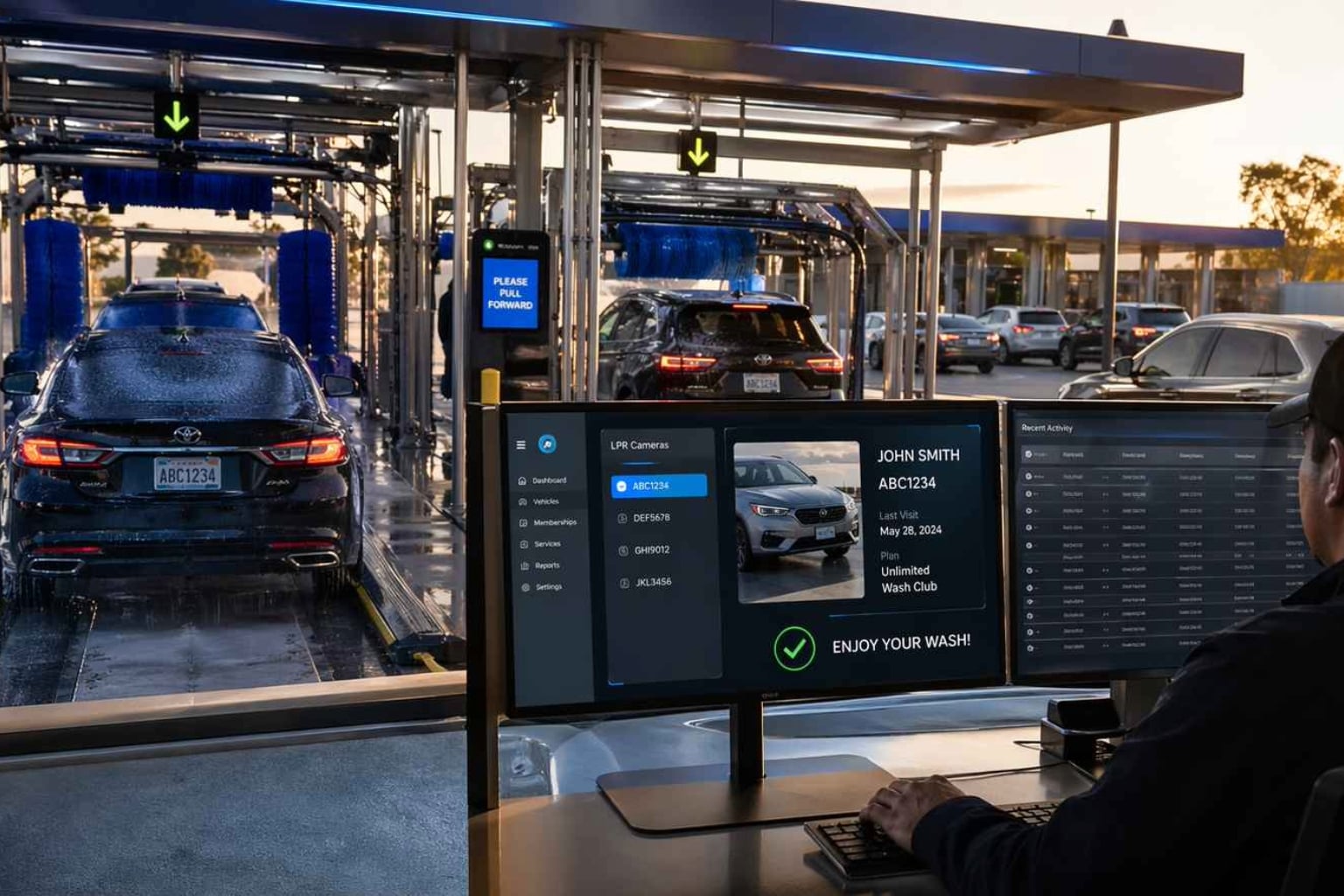
Now, when a customer visits your car wash, the vehicle triggers the automatic sensor system at the entry point. A high-definition camera captures the license plate image. Optical Character Recognition (OCR) software converts the image into readable text. After the information enters the database, the system instantly matches the vehicle to pre-processed data, giving you a complete overview of the customer.
This entire process is known as Automatic Identification and Data Capture (AIDC).
LPR versus RFID: Which one is better?
Many car wash operators employ Radio Frequency Identification (RFID) systems. While RFID and LPR work on the same principles, here’s how RFID differs: with RFID, there is a small microchip inserted into a tag, which is then attached to the vehicle. At the car wash, the RFID reader detects the microchip, and the information is accessed through the database.
To help you decide between LPR and RFID, here are some key pros and cons of each:
- Cost: LPR is more cost-effective in the long run. RFID requires tags, so you will face considerable costs for each tag as your business grows. Also, you will need to manually place tags on vehicles, which is time-consuming and increases costs.
- Marketing: RFID gives your car wash business built-in visibility. When your brand’s RFID tag stays on a vehicle even after the car wash, potential customers can see it. This exposure is a powerful marketing strategy that increases lead generation.
- Accuracy: Car wash operators have noted that both RFID and LPR have accuracy rates of 98% to 99%.
Ultimately, choosing between LPR and RFID will depend on your business’s specific needs and goals.
How does LPR benefit your car wash business?
While the previous section covered a few advantages of LPR, there are more reasons as to why LPR is emerging as a popular choice in the car wash industry:
- Enhanced efficiency: LPR automates and streamlines operations, such as data collection, billing, and payment, resulting in improved efficiency.
- Reduced staff assistance: Manual entry of customer information during each visit becomes unnecessary, which means labor costs are reduced significantly.
- Personalized interactions: LPR enables your team to greet returning customers by name and deliver relevant services based on their past visits, making each experience more meaningful.
- Higher marketing opportunities: Targeted marketing lets you differentiate between non-plan and membership customers. By identifying the two groups, it is easier to upsell memberships and increase revenue.
- Better customer retention: Offer deals and discounts to VIP customers to build a loyal customer base and retain them. Upgrading membership plans also fosters customer retention.
- Integration: Additionally, most LPR systems available today integrate with your existing infrastructure without any issues, so there’s no need for a separate system.
What are some challenges in LPR systems?
Like any technology, implementing LPR also comes with potential challenges. Here are some common difficulties in license plate identification:
- Extreme weather conditions like snow, fog, and rain.
- Poor camera placement choice.
- Glare from sunlight or low light, like at nighttime.
- Physically damaged license plates.
- Plates covered by stickers.
- Dust or mud covering the camera.
- Customized typography.
However, modern LPR systems feature advanced settings that eliminate several challenges, such as night vision, damaged or unique license plates, through AI-powered image correction and multi-frame recognition.
How much does it cost to implement an LPR system?
The cost to implement an LPR system depends on the number of lanes, camera count, camera type, cloud vs on-premise server, integrated systems, and the level of ongoing maintenance you choose.
Usually, companies specializing in LPR systems offer three setups: basic, midrange, and advanced.
Some companies offer subscription models for their entire system, including hardware, software, and continuous repairs, which may be considerably lower.
Answering some frequently asked questions
How quickly can I expect to see ROI?
While it varies from business to business, car wash operators typically report strong ROI within 3 to 18 months. This is based on vehicle throughput, customer memberships, and operational efficiency.
How is customer data stored and protected with LPR?
Customer data is encrypted and stored on cloud-based or on-premise servers. Many LPR systems have role-based access and multi-factor authentication.
What if a customer changes their license plate?
You can manually update the customer’s profile so that the system will read the new license plate next time.
Do LPR cameras see inside the vehicles?
No, they are designed to read only license plates, either from the front or the rear.
What if a customer has multiple vehicles?
Some LPR systems allow you to link several license plates to one account.
If you have a question that has not been answered, or you want to explore how an LPR system can increase efficiency and reduce customer churn, reach out to us to request a demo and see how the Way Car Wash SaaS works.
Main takeaway
License Plate Recognition systems offer flexible setup options and can provide great potential for customer retention and ROI. So, for car wash operators looking to grow their business, LPR systems are a valuable investment. If a License Plate Recognition system is not implemented in your business yet, now is the perfect opportunity to do so.

