How AI is helping auto insurance claims with vehicle damage inspection
Lucy just hit her Prius on the fence. She files a first notice of loss (FNOL). Now your claims team has to go through one of the toughest jobs out there: vehicle damage inspection.
What’s wrong with manual inspection?
For years, the process has remained unchanged.
A customer files a claim and waits for an adjuster to physically inspect the vehicle. The adjuster walks around the car and notes every scratch, dent, crack, and tear. They match the damaged parts to the vehicle’s make, model, year, and trim to price OEM replacements. Then they estimate the labor hours based on local shop rates, which vary by state. All of that gets written up and reviewed before a payout is approved.
If your team is looking at five cars a week, this works well. But for a national insurer processing thousands of claims a week, the cracks slowly start to show: scheduling in-person inspections takes days for every claim, estimates differ between adjusters who are looking at the same damage, fraud becomes harder to catch consistently, and your customers who expect fast service are stuck waiting.
How does AI fit into vehicle damage inspection?
AI isn’t here to replace your claims adjusters. They just take over the boring and time-consuming parts of the job that are done over and over again. This includes detecting scratches, dents, tears, and broken glass.
Detection is honestly only half the work. Then comes turning this detection into a decision. That means every damage is determined whether it can be repaired or needs a full replacement. If replacement is the right call, then the costs of the parts are calculated based on the vehicle’s exact make, year, model, and trim. Or, if it can be repaired, an estimate is made using the local rates.
Since every claim goes through the same detection and pricing process, the same damage gets assessed the same way regardless of which adjuster picks it up. This makes inconsistent estimates easier to flag.
Once it’s ready, it goes to the claims processor. They can either make edits or approve it as is, so that your people still make the major decisions. With AI, a claim that could take days can be reduced to a couple of hours.
How Inspection Repair Tech helps
We built Inspection Repair Tech specifically for insurers that need to bring this kind of speed and consistency to claims. It’s entirely web-based, so there’s no need to install anything.
Here’s what the workflow looks like:
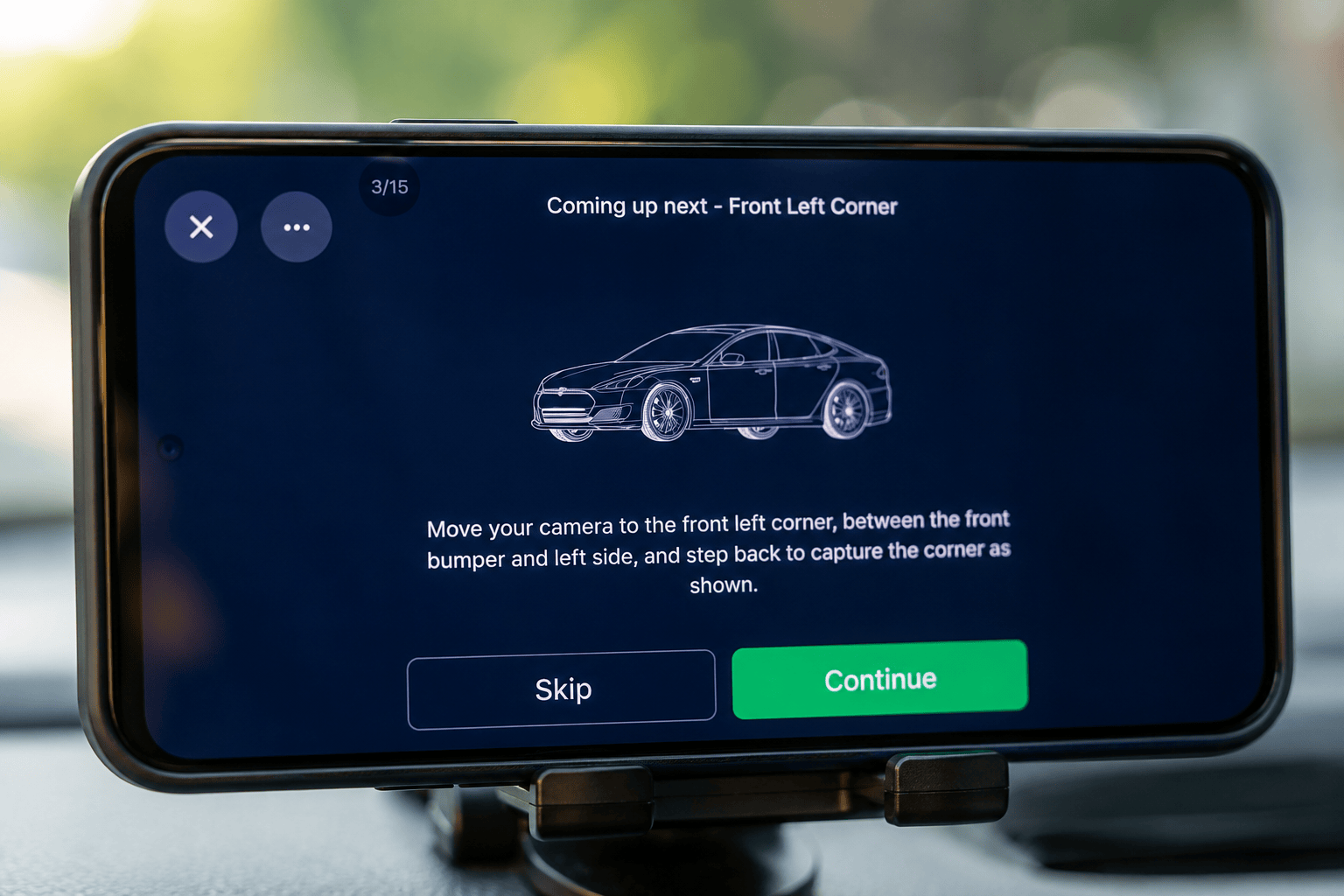
Your team sends the customer a simple link →The customer taps it, is guided through capturing photos of the damaged vehicle directly in their phone’s browser, and submits them → Our AI detects and localizes each type of damage, tags it to the specific part of the car, and assesses the severity.
That output feeds directly into the repair/replace logic and cost estimation, which is ready for a claims processor to review and finalize.
Your policyholders aren’t professionals. The photo quality can vary a lot with shaky hands and bad angles. To prevent photos that are unusable, there are some features we’ve incorporated into our software:
- On-screen prompts like “Move your camera to the rear of the vehicle and step back about 10 feet to capture the full rear, taillights, and license plate”
- If a customer is interrupted mid-capture, they can pick up from the exact position they left off instead of starting over.
- Poor exposure, shadows, depth, and blur are all checked within the device, so the quality isn’t compromised.
- The system won’t accept incomplete photos. It makes sure that the full vehicle is covered and confirms each photo’s angle and side before it can be submitted.
- The photos are queued and uploaded based on the available bandwidth, so the process stays the same even on a weak connection.
Policyholders don’t have to wait in a queue for a week, and your team has a much faster and more consistent claims process.
Want to know how our Inspection Repair Tech can help you? Contact us to schedule a demo!

