What is E85 gas? It’s a high-ethanol flex fuel blend that sits somewhere between your regular pump gasoline and the kind of fuel you’d find on a racetrack. E85 contains between 51% and 83% ethanol depending on the season and your location, with the rest being regular gasoline. It’s designed for Flexible Fuel Vehicles (FFVs) and if your car qualifies, it can be a cheaper and cleaner option at the pump. That said, cheaper per gallon doesn’t always mean cheaper per mile. Here’s what you need to know before making the switch.
What is E85 gas, exactly?
The name throws a lot of people off. E85 is not always 85% ethanol.
In the US, the actual ethanol content can range from 51% to 83%, depending on the season and where you fill up. Cold weather is the reason. Ethanol does not ignite as easily in lower temperatures, so winter blends reduce the ethanol percentage to help engines start properly on freezing mornings.
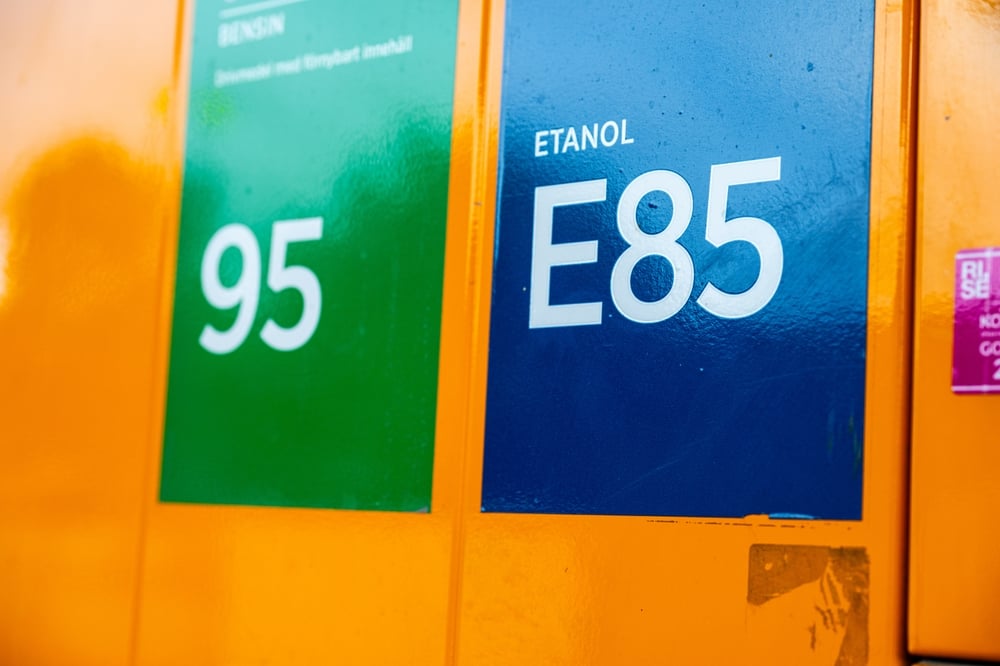
The label on the pump still says E85. What goes into the tank can be something quite different.
At its core, E85 is a flex fuel, a gasoline blend where ethanol does most of the heavy lifting. The “E” is ethanol, the “85” is roughly how much of it is in there. E10, which is 10% ethanol and 90% gasoline, is by far the most common blend you’ll find at the pump. E85 is simply a much higher-ethanol version of that same idea.
How is ethanol made?
Ethanol, also called ethyl alcohol or EtOH, is a colorless liquid made from biomass, which includes plant materials like corn grain. In the US, around 94% of ethanol is derived from corn starch. It’s renewable and domestically produced, which is a big part of the reason the government has backed it for decades.
Production facilities collect the biomass, ferment and distill it into fuel-grade ethanol, then blend it with gasoline before it reaches fuel terminals. One thing worth knowing: ethanol is poisonous and flammable. It is not the same as drinking alcohol and all the safety precautions that apply to regular gasoline apply to E85 and any other flex fuel blend.
E85 vs regular gas: what’s the actual difference?
Gas stations in the US sell three grades of gasoline: regular (87 octane), midgrade and premium. E85 sits completely outside that category.
E85 octane rating vs regular gas
E85 has a much higher octane rating than regular gasoline. Most regular gas sits around 87 octane, while E85 is usually rated at 100 or even higher.
That higher octane helps prevent engine knock, especially under heavy load or hard acceleration. It is one of the main reasons ethanol-based fuels have been used in the Indy 500 for years.
For turbocharged and high-compression engines, E85 can even help produce more horsepower. But the engine usually needs proper tuning before you see those gains.
Energy density and E85 gas mileage
This is where E85 starts losing its advantage. Ethanol has much less energy than regular gasoline. On average, it contains around 27% to 30% less energy per gallon.
Because of that, your engine has to use more fuel to go the same distance. Most drivers notice a drop in fuel economy when using E85. Depending on the vehicle and driving style, gas mileage can fall by 15% to 27%.
For example, a truck that gets 22 MPG on regular gas may only get around 16 or 17 MPG on E85.
E85 price per gallon vs cost per mile
E85 is typically cheaper per gallon than regular gas, often by $0.50–$1.00 in Midwest states where corn is plentiful. But because of the MPG drop, E85 needs to cost roughly 20–25% less per gallon just to break even on a cost-per-mile basis. If that price spread isn’t there at your local station, regular gas is actually cheaper to run mile for mile. Drivers in the corn belt usually see that spread. Coastal drivers usually don’t.
Can you use E85 gas in any car?
No, and this is the most important thing to know. E85 can only be used in Flexible Fuel Vehicles (FFVs). Putting E85 in a car not built for it can damage fuel lines, seals and the engine management system because standard rubber and aluminum parts aren’t designed to handle high-ethanol concentrations.
FFVs are built with ethanol-compatible fuel systems and an engine control unit that reads the ethanol content of the fuel and automatically adjusts fuel injection and ignition timing. You can fill an FFV with any blend of gasoline and ethanol and it handles the adjustment on its own.
What are flexible fuel vehicles (FFVs)?
Flex fuel vehicles have been around since the 1990s. They look identical to regular gasoline cars but come with a modified fuel system and sensors that detect ethanol content in real time.
As of 2025, the number of actively produced FFV models is much smaller than it was ten years ago. General Motors is one of the few manufacturers still building them, with select Chevrolet, GMC and Buick trucks and SUVs offering E85 compatibility. Fleet vehicles like commercial vans and trucks are also commonly available as FFVs.
How to identify an FFV
The easiest place to check is near the fuel cap. Most flex-fuel vehicles have a yellow gas cap or a yellow ring around the fuel filler.
Some models also include badges that say “E85,” “Flex-Fuel,” or “FFV.” You might find them near the fuel door, on the trunk, or along the side of the vehicle.
Still unsure? Check the owner’s manual. You can also look up the VIN through the manufacturer’s database or the US Department of Energy’s alternative fuel vehicle tool.
Can a non-FFV car be converted to run E85?
If you don’t own an FFV but still want to run E85, conversion is possible in some cases. For fuel-injected vehicles built after 1995, a flex fuel conversion typically involves installing an ethanol content sensor, updated control modules and in some cases larger fuel injectors to handle the increased fuel volume E85 requires.
Older vehicles or those with carburetors need more extensive work, including possible replacement of the fuel pump, fuel tank and any rubber fuel lines that aren’t ethanol-compatible.
Conversion adds upfront cost, and the economics only work out if you have reliable access to E85 at a meaningful price discount. If you’re on the coasts where E85 stations are sparse and price differences are thin, the math rarely adds up.
What is the E85 gas price?
E85 gas prices vary by location, time of year and local corn supply. The main reason E85 costs less than regular gasoline comes down to subsidies. Corn is the most subsidized crop in the US. Farmers received over $3 billion in federal corn subsidies in 2024 alone, and that cheap corn supply keeps ethanol production costs low.
In Midwest states, E85 typically runs $0.50–$1.00 per gallon below regular unleaded. On the coasts, that gap narrows considerably. In some areas E85 is barely cheaper or no cheaper at all than regular gas. You can check current E85 prices at E85prices.com or through GasBuddy’s station finder.
Where can I find E85 gas near me?
There are currently around 4,200–4,800 E85 gas stations across the US, spread across 44 states. Most are concentrated in Midwest corn-producing states. Illinois, Iowa, Minnesota, Nebraska and Indiana have the highest station density. If you’re on the coasts, stations exist but you’ll need to plan ahead.
You can locate E85 fuel stations using the Alternative Fuels Station Locator from the US Department of Energy or through apps like GasBuddy and E85prices.com. Many /gas-stations also let you filter by fuel type.
E85 pros and cons: the honest breakdown
Reasons to use E85
Cleaner emissions: E85 produces up to 46% fewer lifecycle greenhouse gas emissions than regular gasoline. The carbon dioxide released when burning ethanol is partially offset by the crops grown to produce it, which is something petroleum products can’t claim.
Higher octane for performance: With an octane rating above 100, E85 resists engine knock better than any pump gasoline. For turbocharged vehicles properly tuned for E85, power gains of 10–20% over regular pump gas are achievable.
Engine cleanliness: Ethanol is a solvent that doesn’t leave burning deposits the way gasoline does. It actively cleans fuel injectors, valves and the exhaust system over time, which can reduce long-term maintenance costs.
Lower price per gallon: In most US markets, E85 costs less per gallon than regular gas, sometimes by a significant margin if you’re in the Midwest.
Domestic and renewable: Nearly all US ethanol comes from American-grown corn, which reduces dependence on imported oil.
Reasons to think twice about E85
Lower fuel economy: Expect a 15–25% drop in MPG if you are using E85. Whether the cheaper per-gallon price offsets that loss depends on the price spread at your specific location.
Limited station availability: About 4,200 to 4,800 gas stations in the US have E85 gas compared to regular gasoline available at nearly 150,000 stations nationwide. Outside the Midwest, finding E85 can feel like looking for a needle in a haystack.
Cold weather performance: E85 can cause hard starts when temperatures drop really low. That happens because ethanol does not perform as well in cold weather. Winter fuel blends reduce the ethanol content to help engines start more easily, but drivers in colder states should still keep it in mind.
Vehicle compatibility: Most cars on the road can’t use E85. Without an FFV or a proper conversion, the fuel simply isn’t an option.
Frequently asked questions about E85 gas
What does E85 stand for?
E85 stands for a fuel blend containing approximately 85% ethanol and 15% gasoline. In the US, the actual ethanol content varies from 51% to 83% depending on the season, since colder months require lower ethanol levels for reliable cold-weather starting.
Is E85 better than regular gas?
That mostly depends on where you live. In many Midwest states, E85 can cost around $0.70 less per gallon than regular gasoline. When the price gap is that big, it can make a lot of sense to use it.
You get higher octane, a cleaner burn, and a cheaper fill-up at the pump. For some drivers, that is enough to make the tradeoff worth it.
But E85 gives back 15–25% fewer miles per gallon than regular gas. So that cheaper price per gallon shrinks fast once you factor in how much more of it you’re burning. The general rule: E85 needs to cost at least 20–25% less than regular gas just to break even per mile. In corn-belt states that spread usually exists. On the coasts it often doesn’t, and you end up paying more without realising it.
Can I put E85 in a regular car?
No. E85 should only be used in Flexible Fuel Vehicles. Regular cars don’t have the ethanol-compatible fuel systems or engine management software to handle high ethanol concentrations. Using E85 in a standard vehicle can damage rubber seals, fuel lines and injectors over time.
How do I know if my car is a flex fuel vehicle?
Look for a yellow gas cap or a yellow ring around the fuel filler opening. Many FFVs carry a badge near the fuel door reading “E85,” “Flex-Fuel” or “FFV.” You can also check your owner’s manual or search your vehicle’s make, model and year on the manufacturer’s website or the US DOE’s Alternative Fuels vehicle database.
What is the octane rating of E85?
E85 has an octane rating of approximately 100 to 105 (R+M/2). Regular gasoline is 87 and premium tops out at 91–93. The higher octane makes E85 more resistant to engine knock, which is why it’s used in performance and racing applications.
Is E85 ethanol free of gasoline?
No. E85 is not pure ethanol. It’s a blend of mostly ethanol with about 15% regular gasoline. In winter months, the gasoline percentage increases further to help with cold-weather starting. Pure ethanol would be labeled E100, which is used in some other countries but not available at US retail stations.
Does E85 damage your engine?
E85 won’t damage an engine built for it. In an FFV it’s completely safe and can keep the engine cleaner over time due to ethanol’s solvent properties. The risk is using E85 in a vehicle not designed for it. That’s where damage to fuel system components can occur.
How much does E85 save compared to regular gas?
E85 is usually cheaper than regular gas at the pump. In most areas, the price difference is somewhere between $0.30 and $1.00 per gallon.
But there is a catch. Since E85 gives lower fuel economy, the cheaper price does not always mean you are saving money overall. In most cases, E85 needs to cost at least 20% to 25% less per gallon before it becomes cheaper per mile driven.
That is why it is important to compare local fuel prices and your vehicle’s MPG before switching to E85 full time.
Does E85 reduce emissions?
Yes. E85 produces roughly 46% fewer lifecycle greenhouse gas emissions than regular gasoline according to the Renewable Fuels Association. It also emits lower levels of carbon monoxide, hydrocarbons and the carcinogen benzene at the tailpipe compared to standard gasoline.
What cars use E85 in 2025?
As of 2025, General Motors produces the most flex fuel vehicles, including select configurations of the Chevrolet Silverado, GMC Sierra, Chevy Trax, Chevy Trailblazer, Buick Encore GX and Buick Envista. Fleet vehicles like commercial vans and trucks are also commonly available as FFVs. The number of new FFV models has dropped considerably compared to a decade ago.
Is E85 the same as flex fuel?
Yes, in the US context E85 and flex fuel refer to the same thing. Flex fuel is the broader term for any high-ethanol gasoline blend and E85 is the most widely available version of it. The two terms are used interchangeably at most gas stations and in vehicle documentation.
Where is E85 available near me?
There are around 4,200–4,800 E85 stations across the US, mostly concentrated in Midwest states. You can find your nearest station using the US DOE’s Alternative Fuels Station Locator, E85prices.com or GasBuddy’s fuel type filter. But, the best way to save while filling up your tank with E85 gas is to locate the gas station using Way app. In that way you will save up to 25¢/gal on gas refills.
Can E85 improve horsepower?
For vehicles properly tuned for E85, yes. The higher octane rating allows for more aggressive ignition timing and higher boost pressure in turbocharged setups, which can produce 10–20% power gains over regular pump gas. Stock, untuned engines won’t see those gains. The benefit comes from tuning the engine to actually take advantage of the fuel’s knock resistance.

Aaron Marshall grew up in a house where cars were never just transportation. Weekend projects, road trips, heated opinions on engine specs at dinner. That stuff never left him. He joined Way in 2023 and has been writing about cars and what it actually costs to own one ever since.