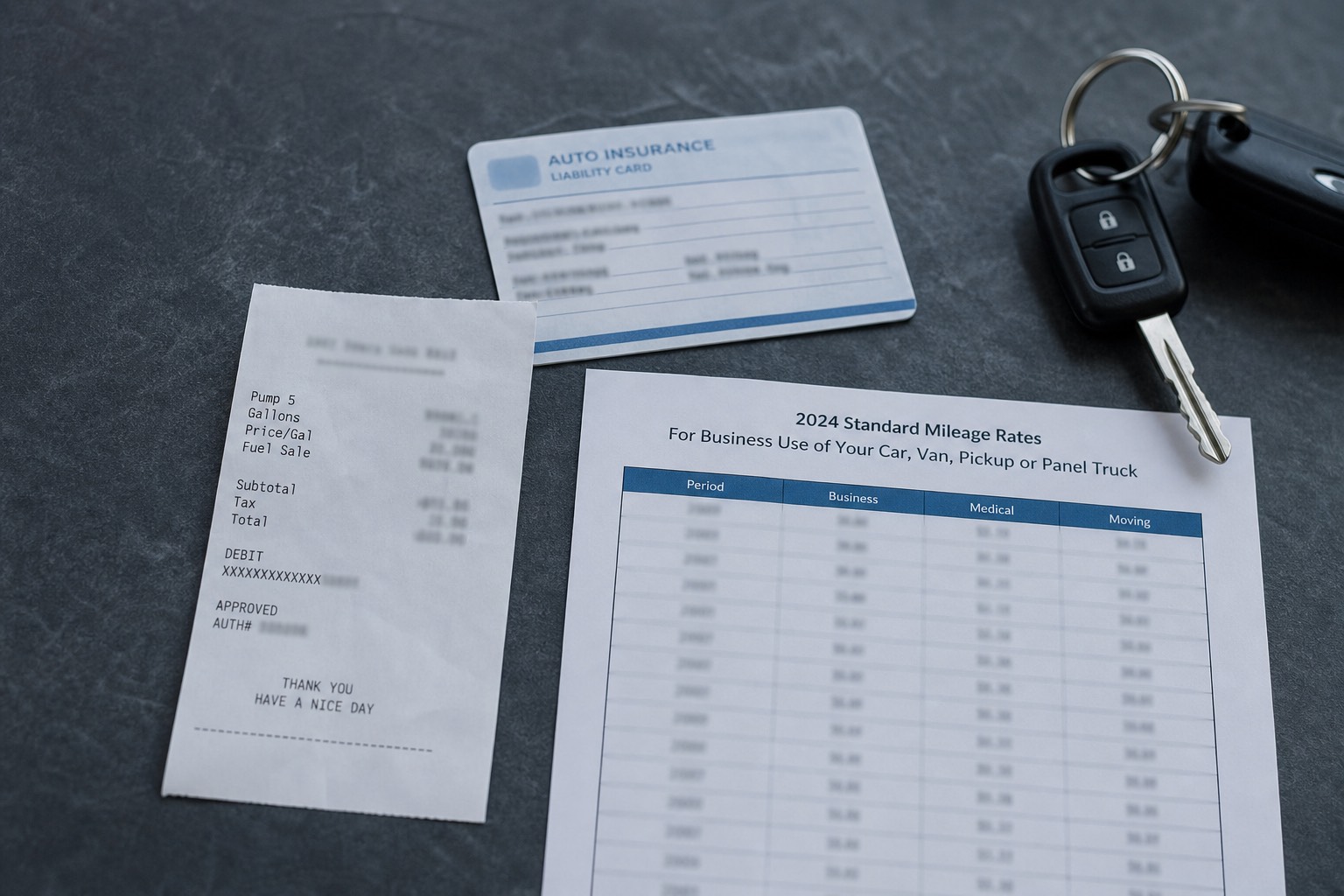
Standard mileage rate vs. actual vehicle expenses is the choice between multiplying qualifying business miles by an IRS rate, or totaling what the car actually cost and applying the business-use share. Same problem, two different calculations, and the gap can be thousands of dollars.
Neither method wins automatically. The right answer depends on the vehicle, the mileage, the operating costs, the business-use percentage, and choices you may have already locked in. For 2026 you also have to split the year: 72.5 cents per mile through June 30, 76 cents from July 1.
Key takeaways
- The standard rate trades paperwork for a fixed per-mile figure. Actual expenses trade effort for precision.
- The standard rate already represents fuel, repairs, insurance and depreciation — do not add those on top.
- You need mileage records either way, because actual expenses need a business-use percentage.
- On a vehicle you own, using the standard rate in the first business year generally keeps it available later. Starting with actual expenses and claiming accelerated depreciation or Section 179 is what typically locks you out of the standard rate for that vehicle.
- A lease that uses the standard rate generally has to keep using it for the whole lease, including renewals.
The Two Methods at a Glance
| Factor | Standard mileage rate | Actual vehicle expenses |
|---|---|---|
| Calculation | Business miles × period rate | Eligible costs × business-use % |
| Mileage log | Essential | Essential |
| Receipts | Lighter for operating costs | Extensive |
| Fuel, repairs, insurance | Inside the rate | Tracked as actual costs |
| Depreciation | Built into the rate | Calculated under the applicable rules |
| Advantage | Simpler | Uses your real costs |
What the Standard Rate Covers
You track qualifying business miles and multiply by the IRS rate for that period. Eight thousand miles in the second half of 2026 at 76 cents is $6,080. The rate is based on a study of fixed and variable automobile costs. It is not a gasoline allowance, which is why you generally should not add fuel, repairs and insurance on top of it.
Parking and tolls attributable to business use can usually sit outside the rate. Confirm that in Publication 463 before you add anything.
| 2026 period | Business rate |
|---|---|
| January 1 – June 30 | 72.5 cents per mile |
| July 1 – December 31 | 76 cents per mile |
What Actual Expenses Cover
You total allowable costs of running the vehicle — fuel or charging, oil, repairs, maintenance, tires, insurance, registration, depreciation, and lease costs where they apply — then apply the business-use percentage.
If eligible costs are $14,000 and business use is 75%, the simplified allocation is $10,500, before limitations and depreciation rules. That only works if the receipts exist and the mileage record supports the 75%.
Why Mileage Records Matter Either Way
Twenty thousand total miles and 12,000 documented business miles is 60% business use. Fifteen thousand dollars of eligible costs × 60% = $9,000. Without the miles, the percentage is a guess. How to keep that record is in how to keep an IRS mileage log. Compiling it for a CPA or an employer is a mileage report.
Way Mileage Tracker can capture the trips so the percentage is not reconstructed in April. Capture is not classification; that remains yours, as in tracker vs. manual logs.
A Worked Comparison
A consultant drives 14,000 business miles: 7,000 in each half of 2026.
Standard rate: 7,000 × $0.725 = $5,075, plus 7,000 × $0.76 = $5,320, total $10,395.
Suppose allowable actual costs are $12,000 and business use is 90%. Actual method: $12,000 × 90% = $10,800.
The actual method wins by $405 in this illustration. Swap in one expensive repair, a different depreciation position, or a lower business-use percentage and it flips. The lesson is to run both calculations, not to assume.
Can You Switch?
For a vehicle you own, if you want the standard rate available in later years you generally have to choose it in the first year the vehicle is available for business use. After that you can usually alternate, subject to the rules. Starting with actual expenses does not by itself lock you out. Claiming accelerated depreciation or Section 179 on that vehicle is what typically does. Straight-line depreciation may leave the standard rate available — confirm with your accountant.
Leased vehicles are stricter: use the standard rate on a lease and you generally must keep using it for the entire lease, including renewals.
How to Choose
- Track business mileage with dates. Split 2026 at July 1.
- Total actual vehicle costs and apply business-use percentage.
- Compare the two deductible amounts under the rules that apply to you, not gross spend.
- If the numbers are close, the simpler method is often worth more than a thin margin.
- Look past this year: depreciation, ownership, the lease rule and the first-year choice all outlast the current return.
The standard rate tends to look better when you drive a lot of business miles in a reasonably cheap-to-run car and want less paperwork. Actual expenses tend to look better when repairs, insurance or allowable depreciation are large and business use is high.
Frequently Asked Questions
Is the standard mileage rate always better?
No. It depends on miles, real operating costs, business-use percentage, depreciation and the rules that apply to you. Run both numbers.
Can I claim the standard rate and my fuel receipts?
Generally no. Fuel, repairs, insurance and depreciation are already represented in the rate. Business parking and tolls are the usual separate items.
Do I need a mileage log for actual expenses?
Yes. The log supports the business-use percentage that scales the costs.
What if I already claimed Section 179 on this car?
That is the typical lock-in. You usually cannot switch that same vehicle to the standard rate later. Ask your accountant about your facts, including any straight-line depreciation.
Does the standard rate apply to EVs?
Yes. The 2026 business rates cover electric and hybrid vehicles as well as gasoline and diesel. Actual expenses for an EV need clean charging records, including home electricity that is mixed with household use.
What if I use the car for an employer reimbursement and a deduction?
Those are different systems. See mileage reimbursement. Do not claim the same cost twice.
Run Both Numbers
Track the miles with dates. Total the real costs. Apply the percentage. Compare. Then look at the first-year and lease rules before you file. The record that makes both calculations possible is the same log — and you can capture it with Way Mileage Tracker instead of rebuilding the year from memory.
Get 10% off in the Way App in the Way App!

- Scan and get the Way App Download the Way App
- Log in to your account
- Use code FIRST10 at checkout