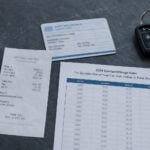
How to keep an IRS mileage log for accurate tax records is less about the notebook and more about connecting each qualifying trip to a date, destination, business purpose and distance while you still remember it.
For 2026 the IRS business standard mileage rate is 72.5 cents per mile from January 1 through June 30 and 76 cents per mile from July 1 through December 31. A log that only stores an annual total cannot apply those two rates correctly, and it cannot explain a trip if the return is examined.
Key takeaways
- An IRS mileage log should show who drove where, when, how far, and why it was business.
- Records made at or near the time of the trip are stronger than anything reconstructed at tax time.
- You cannot deduct amounts you merely approximate or estimate.
- Regular commuting is generally not business mileage. GPS does not decide that for you.
- Mileage records matter under both the standard rate and actual expenses, because actual expenses need a business-use percentage.
What an IRS Mileage Log Is
It is a written or electronic record of qualifying vehicle use. Publication 463 says you need the mileage for each business use, total mileage for the year, the date, the destination and the business purpose.
A sales visit recorded the same day might look like this:
August 12, 2026 — company office to customer location — customer meeting — odometer 28,410 to 28,452 — 42 business miles.
That entry is useful because it was created close to the trip, not remembered in March.
What to Record
| Detail | What to capture |
|---|---|
| Date | The day of the trip |
| Start and destination | Where it began and ended |
| Business purpose | Why the trip was necessary |
| Odometer | Start and end readings, plus year-start, year-end, and mid-year when use changes |
| Business miles | The qualifying distance for that trip |
| Vehicle | Which car, if you use more than one |
How to Keep the Log
- Start at the beginning of the year — or the day the vehicle enters business use. Write down the odometer.
- Record each qualifying trip the same day. Consistency beats a perfect template.
- Separate business and personal driving. A personal stop after a client visit is not automatically business.
- Track total vehicle mileage so you can show the business-use share.
- Keep supporting records for parking, tolls and, if you use actual expenses, fuel, repairs and insurance. Business parking and tolls can generally be claimed separately even when you use the standard rate.
A weekly five-minute review is cheaper than reconstructing a quarter. If you need the compiled version for payroll or a CPA, that is a mileage report.
Which Trips Count
Business transportation generally includes travel between workplaces, visits to clients or customers, meetings away from a regular workplace, and certain trips to temporary workplaces. Regular home-to-work commuting is generally not deductible.
| Situation | Usually business? |
|---|---|
| Office to warehouse | Yes |
| Client appointment | Yes |
| Supplier or supply run | Generally yes |
| Customer delivery | Generally yes |
| Temporary workplace | Depends on the facts |
| Home to regular office | Generally no |
| Personal errand or appointment | No |
| Client visit, then a personal stop | Only the business portion |
A tracker can record that the car moved. You still decide whether the trip was business. That classification problem is the same one in mileage reimbursement.
The 2026 Rates
| Period | Business standard mileage rate |
|---|---|
| January 1 – June 30, 2026 | 72.5 cents per mile |
| July 1 – December 31, 2026 | 76 cents per mile |
Four thousand business miles in the first half and five thousand in the second is $2,900 + $3,800 = $6,700 under the standard rate, before the rest of the return. Using 76 cents on the January miles would overstate it.
Why the Log Matters Either Method
The standard rate multiplies qualifying miles by the period rate. Actual expenses total allowable vehicle costs and apply the business-use percentage. Both need a mileage record. Without it you cannot support the rate calculation or the percentage. How to choose between them is in standard mileage rate vs. actual vehicle expenses.
Using an App
The IRS does not require a commercial app. A notebook or spreadsheet is fine if it is complete and timely. An app helps frequent drivers because it captures the trip instead of asking you to remember it.
Way Mileage Tracker uses GPS to detect drives and lets you classify them as business or personal, then export a report. GPS still cannot tell a client meeting from a grocery run. Compare the two approaches in mileage tracker app vs. manual mileage logs.
Mistakes to Avoid
- Estimating a year-end total instead of documenting trips
- Recording only miles, with no purpose or destination
- Claiming the regular commute
- Ignoring personal use of a mixed-use vehicle
- Reconstructing the year from memory
- Assuming an app makes every mile deductible
- Applying one 2026 rate to the whole year
If you never kept a log, do not invent a number. Use appointments, invoices, toll records and GPS history to reconstruct what you can, then start recording going forward. Large gaps are a reason to talk to a tax professional.
Frequently Asked Questions
What should an IRS mileage log include?
Date, destination, business purpose and miles for each business use, plus enough total-mileage information to show business versus personal use. Beginning and ending odometer readings strengthen the record.
Can I use a mileage tracker app instead of paper?
Yes, if the electronic record has the required information. The app logs movement; you still classify trips and state the purpose.
Is commuting deductible?
Generally no. Daily travel between home and a regular workplace is commuting. Temporary workplaces and a qualifying home office can change that — check Publication 463 for your facts.
What is the 2026 IRS business mileage rate?
72.5 cents per mile from January 1 through June 30, and 76 cents per mile from July 1 through December 31.
Do I need to track personal miles?
You need enough information to separate business use from personal use and to establish total vehicle miles. The personal portion is not deductible.
Can I estimate mileage at tax time?
You should not rely on unsupported estimates. The IRS says you cannot deduct amounts that are merely approximated or estimated.
Is a spreadsheet good enough?
Yes, if you maintain it consistently and it holds the required details. The IRS does not mandate a format.
A Log You Can Explain
Keep the log while the trip is still in front of you. Date, destination, purpose, miles. Separate personal driving. Track the odometer when the year — or the vehicle’s business use — starts and ends. The 2026 split rate makes those dates part of the math, not decoration. If you want the capture step automated, use Way Mileage Tracker and treat classification as the job that remains yours.
Get 10% off in the Way App in the Way App!

- Scan and get the Way App Download the Way App
- Log in to your account
- Use code FIRST10 at checkout